


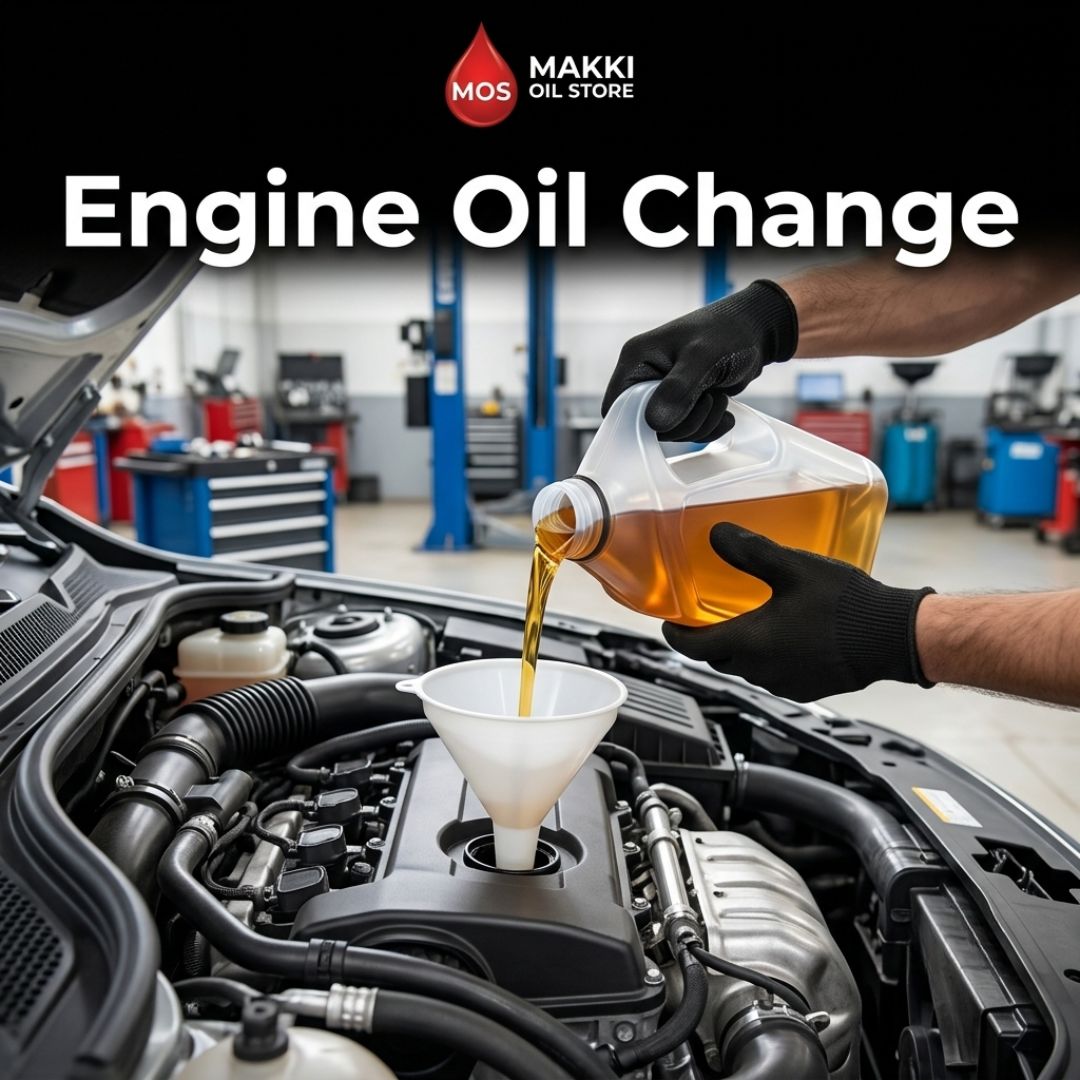
Driving in Lahore presents a unique set of challenges for any vehicle. From the unrelenting summer heat to the gridlock of daily commutes, your car’s engine operates under what mechanics classify as “severe” conditions. While many modern car manuals suggest long service intervals, sometimes up to 10,000 or 15,000 kilometers, these guidelines are often based on ideal, light-duty usage. In the reality of our city’s traffic, understanding when to change engine oil is the most important decision you can make for your vehicle’s longevity.
Why Lahore’s Traffic Qualifies as “Severe” Service
Engineers define “severe” driving conditions not by how hard you push your car but by the stresses placed on the engine’s internal chemistry. In Lahore, most of us encounter these conditions daily:
- Stop-and-Go Congestion: Constant acceleration and deceleration, combined with long periods of idling, prevent the engine from reaching a stable operating temperature. This leads to moisture buildup and fuel dilution in the oil.
- Extreme Heat: Our summer temperatures accelerate the oxidation of engine oil. When oil oxidizes, it thickens, loses its lubricity, and eventually turns into sludge.
- Dust and Particulates: Lahore’s high levels of road dust can infiltrate the intake system. Even with a good filter, microscopic particles eventually make their way into the oil, where they act as an abrasive grit.
Because of these factors, the standard intervals recommended in your owner’s manual for “normal” conditions simply do not apply to our local environment. For most daily drivers in Lahore, an interval of 5,000 kilometers is a much safer, more realistic benchmark for engine health.
The Consequences of Delaying Your Oil Change
Every time you delay an oil change, you are essentially gambling with your engine’s internal components. Fresh oil contains a precise balance of detergents and dispersants that clean the engine and keep contaminants in suspension. Over time, these additives deplete. If you continue driving with “exhausted” oil, those contaminants begin to bake onto critical surfaces like piston rings and valve stems.
This buildup leads to increased friction, higher operating temperatures, and a gradual decline in fuel economy. Eventually, the sludge can clog the oil pickup screen, starving the engine of pressure and leading to catastrophic failure. You can learn more about managing these risks by understanding how often you should change engine oil in Lahore’s dusty traffic to avoid these costly repairs.
Establishing a Maintenance Routine
You don’t need to be a mechanic to stay on top of your engine’s health. The most effective strategy is to treat your oil change as a form of insurance. Even if you haven’t hit the 5,000-kilometer mark, if you frequently drive in heavy traffic, you should still consider a change every 3 to 4 months.
At the Makki Oil Store, we consistently see vehicles that could have avoided thousands of rupees in repairs simply by following a more conservative, climate-aware maintenance schedule. By choosing the right grade of oil and ensuring your filter is replaced every single time you service your car, you protect your engine’s power, fuel efficiency, and overall resale value.
Frequently Asked Questions
Why does city traffic degrade engine oil faster than highway driving?
Highway driving allows the engine to run at a constant speed, which keeps the oil at a stable, high temperature. This heat helps evaporate moisture and unburned fuel that may have leaked into the oil. In city traffic, engines often don’t get hot enough to “burn off” these contaminants. As a result, the oil becomes saturated with water and fuel, which breaks down its chemical additives and forces it to lose its protective properties much faster than it would on a long, steady drive.
Should I change my oil based on kilometers or time?
You should prioritize whichever comes first. If you drive extensively, you will reach your kilometer limit quickly. However, if you are a light user who only drives short distances, the oil can still degrade due to oxidation and the accumulation of moisture from short trips. Even if the car sits idle for months, the oil can break down. As a rule of thumb, if you haven’t reached your mileage limit, try to get an oil change at least once every six months to keep the engine internals lubricated and protected.
Is the “5,000 km” rule just a way for shops to make money?
Not at all. While some might think frequent changes are unnecessary, the 5,000 km interval is a well-documented recommendation by automotive experts specifically for “severe” driving environments. Given the heat, dust, and heavy idling we face in Lahore, this interval provides a safety buffer. It ensures that your engine is always running on clean, effective lubricant, which is significantly cheaper than the cost of replacing damaged bearings, pistons, or entire engine blocks due to neglect.
Can I stretch my oil change interval if I use premium synthetic oil?
Premium synthetic oils are indeed more resistant to heat and oxidation than conventional mineral oils. They offer better protection and can certainly last longer. However, even the best synthetic oil cannot stay effective if it is heavily contaminated with dust and fuel soot. While you might safely stretch your interval slightly further than with conventional oil, perhaps to 7,000 km, you should still inspect your oil regularly. If the oil appears thick or gritty, you should change it regardless of how many kilometers you have driven.
What are the “silent” signs that my oil needs to be changed?
Beyond the obvious dashboard light, pay attention to the way your car sounds and behaves. If your engine sounds slightly louder or “rougher” than usual, it may be time for a change. You might also notice a slight drop in fuel efficiency or a lack of responsiveness during acceleration. Checking the oil on your dipstick is the best diagnostic tool: if it’s dark, thick, or has a gritty texture when rubbed between your fingers, it has lost its ability to protect your engine.