In the automotive world, manufacturer manuals often suggest oil change intervals of 10,000 kilometers or more. However, any experienced driver in Pakistan knows that our local reality is quite different. Between the scorching summer heat that pushes thermal limits and the pervasive dust that infiltrates engine systems, the “ideal” conditions described in international manuals rarely apply to our daily commutes. Understanding how long engine oil can truly last requires a realistic look at how our environment degrades lubricants faster than laboratory settings predict.
The Reality of Pakistani Driving Conditions
Your engine’s oil is constantly battling three primary enemies in Pakistan: extreme ambient heat, heavy stop-and-go traffic, and significant airborne dust. When you sit in a traffic jam on a hot afternoon, your engine is idling for long periods without the airflow necessary for efficient cooling. This places immense thermal stress on the oil, accelerating the oxidation process. Simultaneously, the fine dust common on our roads can bypass air filters over time, contaminating the oil and turning it into an abrasive slurry that accelerates engine wear.
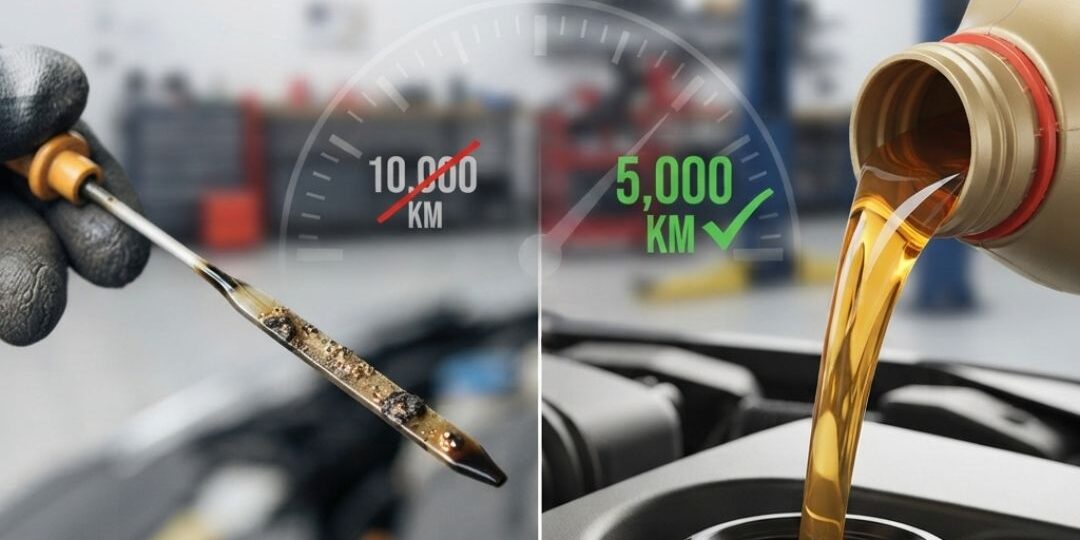
Because of these “severe” driving conditions, most mechanics and seasoned drivers agree that the international 10,000-kilometer mark is an optimistic estimate that does not account for the wear and tear of our streets. To maintain long-term engine health, it is vital to gain a clear perspective on how often you should change engine oil in Lahore’s dusty traffic. Following a more conservative, proactive schedule, typically around 5,000 kilometers, acts as a low-cost insurance policy for your vehicle.
Why Proactive Maintenance Matters
At the Makki Oil Store, we frequently emphasize that the cost of an oil change is a fraction of the cost of engine repairs. When you change your oil at realistic intervals, you are effectively removing the microscopic metal shavings and contaminants that accumulate as you drive. If left in the engine, these contaminants circulate and act like sandpaper on your bearings and cylinder walls. By keeping your oil fresh, you ensure that your engine remains clean, runs cooler, and maintains its fuel efficiency for years longer than a neglected engine.
Frequently Asked Questions
Is 5,000 kilometers a hard rule or a guideline?
It is a sensible guideline for most Pakistani drivers. While your car might technically continue to run past 5,000 kilometers, the protective additives in the oil start to lose their effectiveness after this point due to the heavy load and heat of our local climate. By sticking to this interval, you ensure that your engine is always protected by the freshest possible lubricant, which is essential given that our driving conditions are classified as “severe” by almost every global automotive manufacturer.
Does synthetic oil last longer in Pakistan?
Yes, synthetic oil is chemically more stable than conventional mineral oil and performs better under high temperatures. However, “lasting longer” does not mean you should ignore the effects of contamination. Even if the synthetic base is still good, the oil will still become contaminated with dust and debris from our roads. Therefore, while you may have more peace of mind with a high-quality synthetic, you should still prioritize a consistent, conservative change interval to keep the internal components free from grit and sludge.
Can I stretch my oil change interval if I mostly drive on highways?
Highway driving is generally easier on an engine than city traffic because it allows for constant airflow and steady operating temperatures. If your driving is almost exclusively long-distance highway travel, you might be able to stretch your interval slightly beyond 5,000 kilometers. However, you should still keep a close eye on the oil color and level. Even on highways, Pakistan’s high summer temperatures mean you should never push your oil to the absolute limits specified by international manuals.
What are the signs that my oil is finished before the 5,000 km mark?
If you notice the engine sounds louder or “tappier” than usual, or if you see a noticeable drop in fuel economy, your oil may have degraded prematurely. Additionally, if the oil on the dipstick looks pitch black or has a gritty texture when rubbed between your fingers, it is time for a change regardless of how many kilometers you have traveled. Never wait for a warning light on the dashboard, as that usually indicates a critical pressure issue rather than just degraded oil quality.
Why is the oil filter change so critical?
An oil filter is the engine’s only defense against the dust and carbon particles that accumulate in the oil. In our dusty environment, the filter becomes saturated much faster than in cleaner climates. If you change your oil but keep the old, dirty filter, the fresh oil will instantly be contaminated as it passes through the clogged filter element. Always treat the oil and the filter as a single unit of maintenance; they must be replaced together to ensure your engine stays clean.