


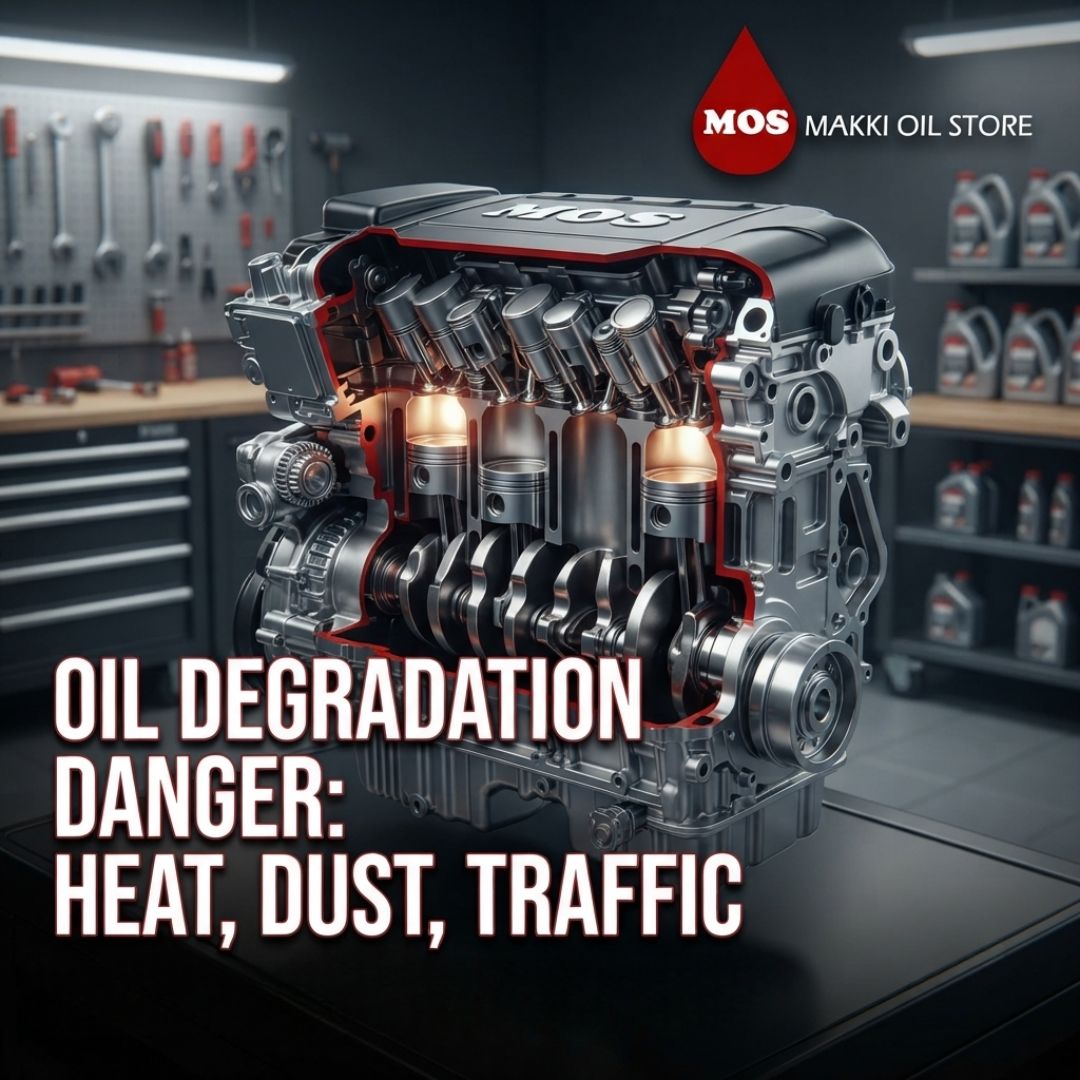
When you read a product manual, it often outlines service intervals based on ideal driving conditions: empty highways, moderate weather, and clean air. However, driving daily in Pakistan introduces an entirely different set of environmental stressors. High ambient temperatures, severe traffic congestion, and heavy airborne dust act as harsh catalysts that accelerate how quickly engine oil degrades, loses its viscosity, and accumulates internal contaminants. Understanding how these factors impact your lubricant is vital for keeping your vehicle protected against premature mechanical wear.
The Triad of Thermal and Environmental Stress
The local driving landscape subjects your engine to continuous punishment. First, ambient heat during long summer months pushes oil temperatures to their limits, thinning the fluid and accelerating oxidation. Second, stop-and-go traffic keeps engines idling for extended periods, reducing airflow through the radiator and forcing the oil to absorb even more thermal energy while failing to benefit from high-speed cooling.
Finally, fine dust particles find their way past compromised air intakes, mixing directly with the lubricant. This abrasive mixture acts like a liquid sandpaper on internal bearings and cylinder walls. Because standard service schedules rarely account for these harsh realities, vehicle owners should read our guide to changing engine oil in Lahore’s dusty traffic to ensure the fluid maintains its structural integrity and protective capability throughout its lifespan.
Maintaining Performance at Makki Oil Store
At the Makki Oil Store, we frequently service cars that show signs of severe thermal breakdown long before reaching their standard mileage markers. When oil is subjected to constant heat and soot contamination, its additives deplete rapidly, turning the fluid into a thick, sludgy mass. Recognizing these environmental pressures allows you to adjust your maintenance habits, ensuring that fresh, high-spec lubricants are introduced into your engine before heat and friction can inflict permanent damage on internal components.
Frequently Asked Questions
Why does heavy traffic cause engine oil to degrade faster?
Heavy traffic forces your car to spend hours idling or moving at very low speeds, which limits the natural airflow through the engine bay and radiator. Without this cooling breeze, internal engine temperatures rise significantly, placing an enormous thermal load on the oil. Furthermore, low-speed stop-and-go driving prevents the engine from reaching its optimal self-cleaning operating temperatures for extended periods, allowing moisture, unburnt fuel residues, and combustion byproducts to accumulate inside the fluid rather than burning off. This combination of elevated heat and chemical accumulation drastically shortens the effective lifespan of the oil.
How does airborne dust mix with engine oil?
Airborne dust enters the engine compartment through the air intake system. If an air filter is old, poorly fitted, or overwhelmed by heavy road dust, microscopic grit bypasses the filter and enters the combustion chambers. From there, these abrasive particles slip past the piston rings during the stroke cycle and drop directly down into the oil pan. Once suspended in the fluid, this dust transforms the lubricant into an abrasive compound that accelerates wear on metal bearings, camshaft lobes, and oil pumps, making clean filters just as critical as the oil itself.
Should I change my oil sooner if I only drive short city distances?
Yes, short city trips are actually considered “severe driving conditions” by most automotive engineers. When you only drive short distances, the engine rarely has enough time to reach its full operating temperature. This prevents moisture from condensing and fuel vapors from evaporating out of the oil, leading to fuel dilution and acidic sludge formation. Even if your total kilometers driven are low over a six-month period, the chemical degradation happening during frequent short trips means you should change your oil based on time rather than mileage alone.
Can high ambient temperatures cause oil to thin out excessively?
Extremely high ambient temperatures can challenge an oil’s viscosity limits, especially if the oil is old or of an incorrect grade. While multi-grade oils are formulated to maintain protection across a wide temperature range, intense and prolonged heat causes the base stock and viscosity modifiers to break down over time. When these polymers shear down, the oil loses its high-temperature film strength, becoming too thin to properly cushion moving parts. This loss of thickness can lead to drops in oil pressure, increased internal friction, and accelerated wear on critical engine components.
What are the warning signs that my oil has broken down from heat and dust?
When oil has degraded past its safe operating window, you may notice several distinct symptoms. The engine may sound noticeably louder or rougher during idle, and you might experience a sluggish throttle response as increased friction robs the motor of its efficiency. Additionally, you may see a drop in fuel economy or notice the oil warning light flickering briefly when coming to a stop. If you pull the dipstick and find the oil looks pitch black, feels gritty, or smells strongly of burnt fuel, it has lost its protective capabilities and must be replaced immediately.