


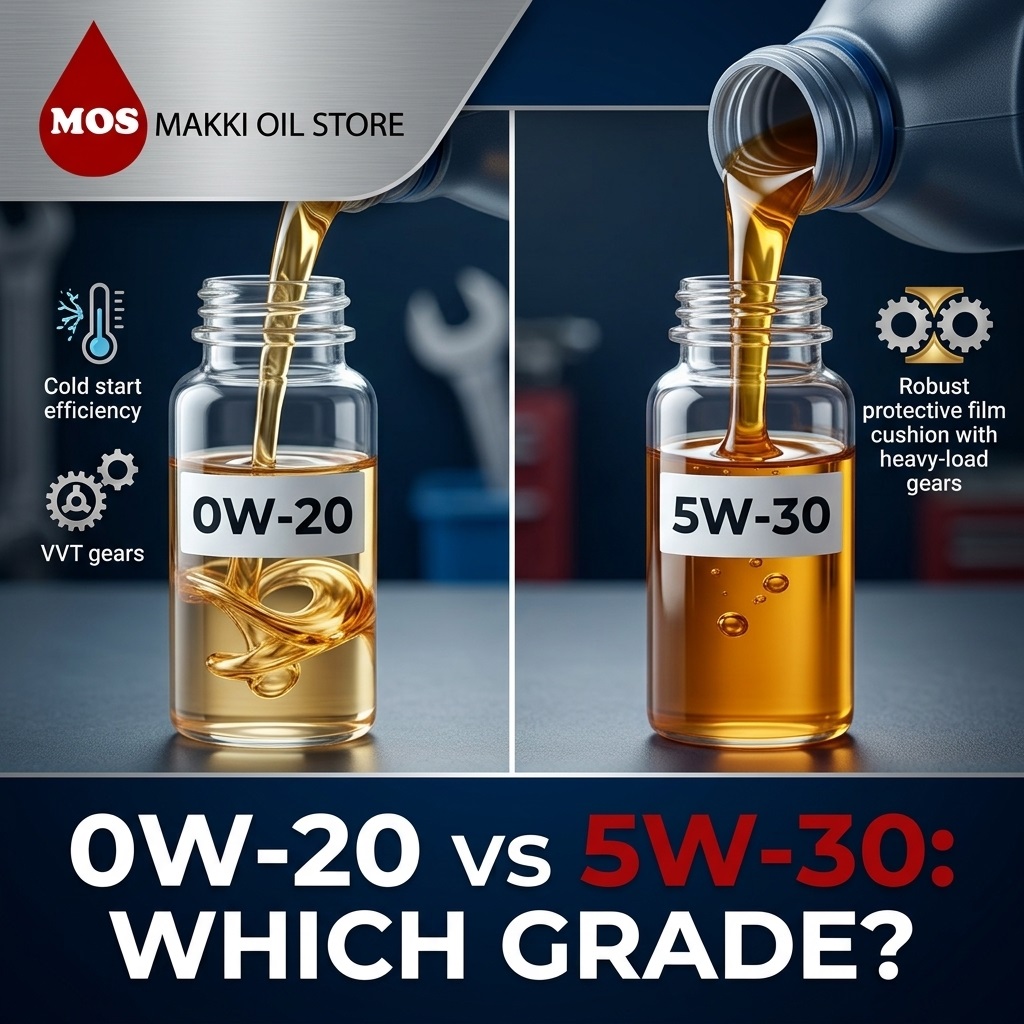
Selecting the correct motor oil for your vehicle is one of the most critical maintenance decisions you will make. Modern automotive engineering has advanced rapidly, moving away from heavy, traditional lubricants toward low-viscosity synthetic formulations designed to maximize fuel efficiency and reduce internal friction. When vehicle owners review factory specifications for modern Japanese, Korean, or European cars, two specific viscosity grades frequently appear: 0W-20 and 5W-30.
Navigating the technical differences between 0W-20 vs 5W-30 can be confusing, especially when balancing manufacturer recommendations against regional driving challenges like Pakistan’s intense summer heat waves and heavy traffic gridlock. Understanding how oil viscosity behaves under varying temperatures ensures your engine stays protected without sacrificing performance.
Decoding Viscosity Ratings and Temperature Behavior
To understand how these two synthetic oils differ, it helps to break down their numerical designations. The number preceding the letter “W” (standing for winter) indicates how well the oil flows at sub-zero temperatures during cold engine starts, while the second number represents the fluid thickness and film strength at normal operating temperatures around 100 degrees Celsius.
- 0W-20: Offers ultra-thin flow characteristics during cold starts, reaching critical engine components rapidly while minimizing internal pumping resistance to save fuel.
- 5W-30: Provides slightly thicker fluid dynamics at operating temperatures, maintaining a robust protective cushion between high-load bearings and cam lobes.
Car owners looking to master the fundamentals of oil labeling can review comprehensive technical breakdowns on how to read engine oil labels what 5w30 10w40 and 20w50 actually mean to understand how additive packages and base stocks govern performance.
The Engineering Behind Low-Viscosity Oils
Automotive manufacturers specify 0W-20 for modern, tight-tolerance engines featuring variable valve timing and precision machining. These modern powerplants are engineered with extremely narrow clearances between moving parts. A thinner oil flows effortlessly through these tight galleries, reducing parasitic drag on the oil pump and boosting fuel economy.
However, many drivers worry that a low-viscosity oil will thin out excessively during peak summer gridlock in cities like Lahore. Modern fully synthetic base oils are engineered with robust shear-stable polymers that maintain stable film strength even under high thermal stress. Nevertheless, switching between grades arbitrarily without consulting your vehicle owner manual can lead to improper oil pressure control or accelerated wear on older engine designs.
Vehicle owners seeking expert guidance on matching lubricant properties to specific engine tolerances can explore foundational selection principles through engine oil selection how to choose the right viscosity to make informed maintenance choices.
| Viscosity Grade | Cold Flow Property (W Rating) | Operating Temp Viscosity | Ideal Engine Type |
| 0W-20 | Superior low-temperature flow | Thinner film at 100C | Modern hybrid engines and tight-tolerance Japanese imports |
| 5W-30 | Standard low-temperature flow | Thicker film at 100C | High-mileage engines, turbocharged units, and heavy loads |
Making the Right Choice for Local Driving Conditions
Choosing between these two grades depends strictly on what your vehicle manufacturer specifies on the oil filler cap or in the owner manual. Modern hybrid vehicles and fuel-efficient economy sedans are calibrated exclusively for 0W-20 to ensure optimal hybrid system integration and low emissions.
Conversely, if your vehicle has accumulated high mileage, undergoes heavy commercial use, or features a high-output turbocharged engine operating under dusty local conditions, a 5W-30 synthetic oil often provides the extra thermal cushion required to prevent metal-on-metal contact.
Motorists seeking professional fluid diagnostics, multi-point inspections, and genuine lubricant selections can explore comprehensive maintenance solutions detailed under our services to keep their engines running smoothly.
For vehicle owners looking for accessible, certified service locations nearby, verifying workshop bays via branches makes it simple to receive expert oil change care.
At the Makki Oil Store, our expert technicians provide transparent guidance, premium synthetic lubricants, and OEM-grade filters, ensuring your vehicle receives the exact oil grade engineered for its peak performance.
Frequently Asked Questions
Can I switch from 5W-30 to 0W-20 in my car engine?
You should only switch to 0W-20 if your vehicle manufacturer explicitly lists it as an approved viscosity grade in your owner manual or on the engine oil filler cap.
Does 0W-20 oil protect well enough during Lahore’s hot summers?
Yes, high-quality fully synthetic 0W-20 oils maintain robust film strength at high operating temperatures, provided your cooling system and oil levels are properly maintained.
What happens if I use 5W-30 in an engine designed for 0W-20?
Using a thicker oil than specified can increase internal pumping friction, slightly reduce fuel economy, and cause sluggish VVT-i actuator response in modern precision engines.
Is synthetic oil mandatory for 0W-20 and 5W-30 grades?
Virtually all 0W-20 oils and high-performance 5W-30 oils are formulated using full synthetic base stocks to achieve their wide temperature operating ranges.
How often should synthetic 0W-20 or 5W-30 oil be changed?
Under normal conditions, high-quality synthetic oils last between 7,000 and 10,000 kilometers, though severe stop-and-go city driving may require earlier replacement.