


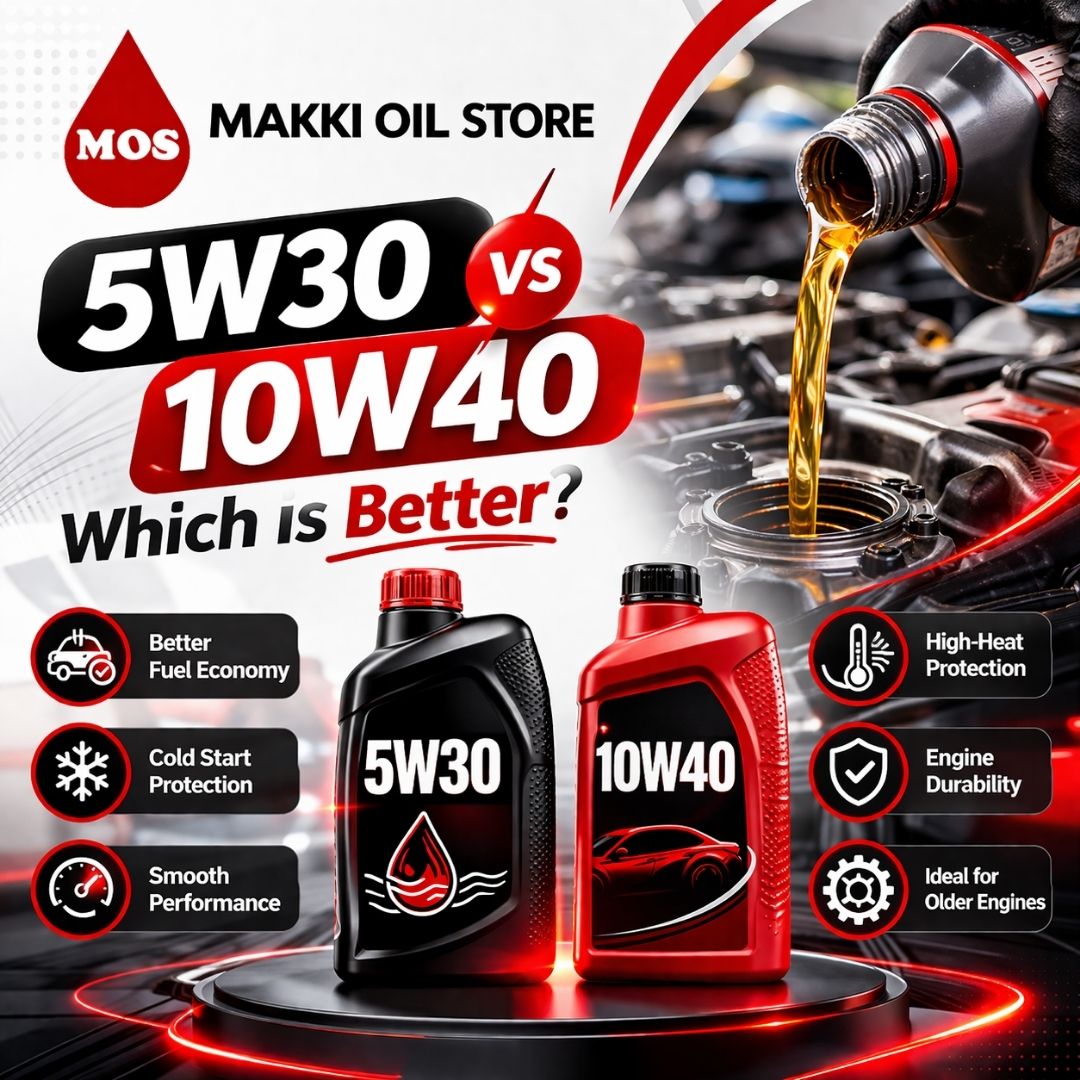
Choosing the right lubricant is often the difference between a smooth-running vehicle and one that spends most of its time at a workshop. In Lahore, where drivers face a unique combination of extreme summer heat and dense morning fog in the winter, the 5W30 vs 10W40 oil debate is incredibly common. Both are multi-grade oils, but they serve different purposes based on the age of your engine and the specific conditions of your daily commute.
Understanding the numbers on the bottle is the first step toward better vehicle maintenance. These ratings aren’t just random digits; they represent how the oil flows at different temperatures. Making the wrong choice can lead to poor fuel economy or, in worse cases, accelerated wear on critical engine components. At Makki Oil Store, we see firsthand how the right selection preserves engine life for our local customers.
Decoding the Difference Between 5W30 and 10W40
To settle the question of which is better 5W30 or 10W40, we must look at viscosity. Viscosity is simply a measure of an oil’s resistance to flow. The first number (followed by a ‘W’ for winter) indicates the oil’s flow during a cold start. The second number indicates the oil’s thickness when the engine reaches its normal operating temperature (usually around 100°C).
When comparing 5W30 vs 10W40 engine oil, the 5W30 is thinner both when cold and when hot. This allows it to circulate faster through the engine during startup, which is when most engine wear occurs. On the other hand, 10W40 is thicker at both ends of the temperature spectrum. This extra “body” provides a more substantial protective film, which can be vital for certain engine types or older vehicles navigating the high-heat environment of a Lahore afternoon.
5W30 Engine Oil Benefits for Modern Vehicles
The move toward 5W30 engine oil benefits modern automotive engineering. Most newer cars are designed with very tight tolerances between moving parts. These engines require a thinner oil that can reach small passages quickly. Because 5W30 is thinner, it creates less internal drag, meaning the engine doesn’t have to work as hard to move its components.
One of the most significant advantages for the local commuter is how it helps you maintain fuel efficiency with the right engine oil. By reducing friction, 5W30 allows the engine to operate more freely, which directly results in better mileage. This makes it an ideal choice for newer sedans and hatchbacks driven daily in areas like DHA or Johar Town.
10W40 Engine Oil Benefits for High-Heat and Older Engines
While 5W30 is great for efficiency, 10W40 engine oil benefits are more pronounced in older vehicles or those that operate under heavy loads. As an engine ages, the gaps between internal parts can widen due to natural wear. A thinner oil like 5W30 might not be able to fill these gaps effectively, leading to a drop in oil pressure or audible engine noise.
The difference between 5W30 and 10W40 becomes clear when the mercury rises. In the peak of summer, a 10W40 oil maintains its thickness better than a 5W30. This ensures that a strong lubricating film remains between the piston rings and the cylinder walls even under intense thermal stress. If you are driving an older model or a high-mileage van through congested traffic, the extra protection of 10W40 can prevent metal-on-metal contact that leads to costly repairs.
Temperature-Based Oil Selection in Lahore
Your choice should ideally mirror your environment and your vehicle’s specific needs. In a city like Lahore, where summer temperatures can exceed 45°C, the “40” in 10W40 provides an extra layer of security. However, for a brand-new car, the manufacturer likely recommends 5W30 to protect those precision-engineered parts and ensure maximum fuel economy.
If you are unsure which grade is currently in your engine or if you should switch based on your car’s mileage, you should read how to choose the right engine oil shop in Lahore for professional assessment. Generally, sticking to the manufacturer’s recommendation is the safest path, but moving to a slightly thicker oil like 10W40 is a common and effective practice for vehicles that have surpassed the 100,000 km mark.
Engine Oil Viscosity Comparison: The Bottom Line
There is no single “winner” in the 5W30 vs 10W40 oil debate. Instead, there is the “right” oil for your specific situation.
- Choose 5W30 if you have a newer vehicle, want better fuel economy, or live in an area where cold starts are a priority. Its superior flow ensures that the upper valve train is lubricated within seconds of turning the key.
- Choose 10W40 if you have an older engine, notice slight oil consumption between changes, or frequently drive in extreme heat under heavy loads. The thicker film provides a better seal for aging components.
Proper lubrication is an investment in your vehicle’s future. Regularly checking your oil level and ensuring you are using the correct grade will keep your engine quiet, cool, and responsive for years to come.
Frequently Asked Questions
Can I mix 5W30 and 10W40 oil in my engine?
While it is physically possible to mix these two oils, it is generally not recommended as a permanent habit. Mixing different viscosities will result in a blend that has an unpredictable flow rate, which may not meet the specific requirements of your engine. In an emergency, it is better to add a different grade than to run the engine with low oil, but you should aim to perform a full oil change with a consistent grade as soon as possible to maintain optimal engine protection.
Does 5W30 work well in the extreme heat of Lahore?
Yes, 5W30 can work well in Lahore, provided it is a high-quality synthetic oil and your engine is designed for it. Many modern synthetic oils are engineered to resist thinning even at very high temperatures. However, if your car is older or has high mileage, the 5W30 might become too thin during a 45°C afternoon, potentially leading to increased wear. In such cases, switching to a 10W40 or even a 20W50 might be more appropriate for the local climate.
Will switching to 10W40 stop my engine from making noise?
If your engine is making a “tapping” or “knocking” sound because the current oil is too thin to fill the gaps between worn parts, switching to 10W40 can often quiet the engine. The thicker oil provides a better cushion and improves oil pressure in older motors. However, if the noise is caused by a serious mechanical failure, a thicker oil is only a temporary mask for a problem that will eventually require a mechanical repair.
Is 5W30 better for fuel economy than 10W40?
Yes, 5W30 is generally better for fuel economy. Because it is thinner, there is less fluid friction for the engine’s internal parts to overcome. This means less energy is wasted moving the oil around the engine, allowing more power to reach the wheels. For modern cars driven primarily in the city, the fuel savings from using 5W30 over a heavier 10W40 can be quite noticeable over several thousand kilometers of driving.
How often should I change my oil if I use 10W40 in an old car?
Even with a thicker oil like 10W40, regular changes are vital. In the dusty and hot conditions of Lahore, we recommend changing your oil every 3,000 to 5,000 kilometers, especially if you are using a mineral-based 10W40. Older engines often produce more combustion by-products that can contaminate the oil, so keeping a fresh supply of lubricant is the best way to prevent the buildup of harmful sludge and carbon deposits.