Vehicle maintenance guidelines published in factory owner manuals are typically engineered for ideal operating environments, smooth highways, and moderate weather. However, motorists navigating the distinct urban landscape of Punjab face an entirely different set of operational challenges. High ambient temperatures, prolonged monsoon humidity, extensive idle times in bumper-to-bumper traffic, and heavy road dust place an extraordinary thermal and mechanical strain on modern lubricants. Understanding how regional climate extremes dictate your maintenance schedule is crucial for preserving engine longevity, optimizing fuel economy, and ensuring an effective engine oil change is performed precisely when your vehicle needs it most.
Environmental Stressors and Thermal Breakdown
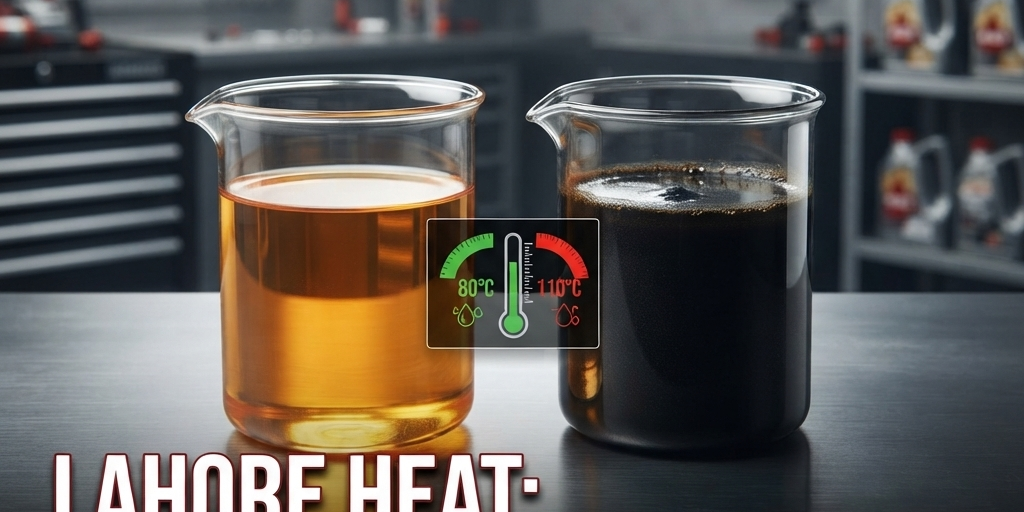
The primary factor reducing the lifespan of automotive lubricants in urban Pakistan is the relentless intensity of the local climate. During summer months, ambient temperatures soar past forty degrees Celsius, pushing underhood operating temperatures to extreme levels. This excessive heat causes standard mineral oils to thin out rapidly, losing their protective viscosity and failing to maintain a stable lubricating film between fast-moving metal components like piston rings, camshafts, and crankshaft bearings.
Beyond soaring temperatures, environmental particulate pollution poses a constant hazard. Fine road dust and construction debris bypass aging air filters over time, mixing directly with the lubricant to form an abrasive sludge that accelerates internal wear. To understand the complex science behind how harsh environmental factors degrade fluid efficacy, vehicle owners can review detailed insights on how engine oil changes with heat, dust, and traffic to see why standard factory mileage intervals must often be shortened for local driving conditions.
Differentiating Oil Types and Local Service Intervals
Not all lubricants are formulated to withstand extreme stress equally. Choosing the correct formulation depends heavily on whether your vehicle runs on conventional mineral oil, semi-synthetic blends, or advanced full-synthetic compounds.
- Conventional Mineral Oils: Sourced directly from crude petroleum, these oils break down quickly under high thermal stress and typically require replacement every 3,000 to 5,000 kilometers in urban environments.
- Semi-Synthetic Blends: Combining mineral and synthetic bases, these oils offer better thermal resistance and are well-suited for moderate commuter schedules, usually lasting between 5,000 and 7,000 kilometers.
- Full-Synthetic Oils: Engineered in laboratories to maintain molecular stability across wide temperature ranges, premium synthetics can endure up to 10,000 kilometers or more, provided the vehicle is not subjected to severe continuous idling.
Navigating the peak summer season requires paying close attention to how thermal intensity alters fluid pressure and viscosity retention. Motorists looking to protect their engines from seasonal heat spikes can explore how Lahore’s summer heat affects your engine oil life to master effective preventive care during peak temperature waves.
| Lubricant Classification | Typical Highway Lifespan | Recommended Urban Interval in Lahore | Primary Performance Benefit |
| Mineral Oil | 5,000 km | 3,000 to 4,000 km | Economical choice for older engine architectures |
| Semi-Synthetic Oil | 8,000 km | 5,000 to 6,000 km | Balanced thermal resistance and cost efficiency |
| Full-Synthetic Oil | 12,000+ km | 8,000 to 10,000 km | Superior shear stability and heat protection |
The Impact of Urban Congestion and Idling
Daily commuting through congested corridors like Jail Road, Ferozepur Road, or the Main Boulevard involves hours of crawling traffic, frequent stopping, and prolonged idling. Many drivers assume that because their odometer is not registering high mileage while idling, the engine is experiencing zero wear. In reality, idling puts heavy strain on the engine because oil pump rotation speeds are lower, delivering reduced fluid volume to critical upper valvetrain components while combustion heat continues to build up inside the block.
Furthermore, frequent stop-and-go driving prevents the engine from reaching its optimal self-cleaning operating temperature, allowing fuel dilution and moisture condensation to contaminate the oil pan. Factoring in these idle hours means you should monitor your engine oil change schedule by tracking engine operating hours alongside total kilometers driven.
Professional Servicing and Quality Assurance
Sourcing authentic, factory-sealed lubricants is just as critical as choosing the correct viscosity grade. The automotive market contains various counterfeit oils that mimic leading international brands but lack proper anti-wear additive packages, leading to varnish buildup and internal engine damage.
At the Makki Oil Store, our specialists provide certified, high-performance lubricants designed to withstand regional thermal extremes. Ensuring that your engine receives genuine synthetic or semi-synthetic fluid paired with a high-efficiency oil filter guarantees maximum protection and reliable performance throughout the year.
Frequently Asked Questions
How can I tell if my engine oil needs to be changed before reaching my mileage limit?
You can assess your engine oil condition by pulling out the dipstick, wiping it on a clean white tissue, and observing its color and texture. While fresh oil is amber and translucent, used oil naturally darkens due to soot accumulation. However, if the oil appears thick, gritty, pitch black, or emits a strong burnt odor, it has broken down thermally and requires an immediate change regardless of how many kilometers you have driven.
Does synthetic oil last longer than conventional oil in hot climates?
Yes, full-synthetic oils possess superior molecular stability and resistance to thermal breakdown compared to conventional mineral oils. While intense heat causes conventional oil to thin out and evaporate quickly, synthetic formulations maintain their protective viscosity across wider temperature ranges. This makes full-synthetic oils a much safer and more cost-effective long-term choice for vehicles operating in high-temperature urban environments.
What happens if I delay my engine oil change past the recommended interval?
Delaying your engine oil change causes the lubricant to oxidize, thicken, and transform into a tar-like sludge that clogs narrow oil passages. Without a continuous, clean film of lubrication, internal metal components experience severe friction, leading to warped cylinder walls, worn camshaft lobes, and eventual engine seizure. Timely oil changes prevent these catastrophic repair bills.
Should I change my oil filter every single time I change my engine oil?
Yes, replacing the oil filter during every single oil change is standard best practice. An old oil filter is already choked with trapped metal shavings, soot, and carbon deposits from your previous fluid cycle. Pouring fresh oil through a dirty filter immediately contaminates the new fluid with leftover sludge, drastically cutting down its effective cleaning lifespan.
Does driving short distances in the city affect oil lifespan?
Short city trips where the engine never fully reaches its optimal operating temperature are actually harsher on engine oil than long highway drives. Short trips allow unburned fuel condensation and moisture to accumulate inside the crankcase without evaporating, leading to oil dilution and accelerated chemical breakdown. Vehicles driven primarily on short urban commutes require more frequent fluid inspections and changes.
Meet the Author
Muhammad Ikram | Founder of Makki Oil Store
With over 25 years of practical industry experience, Muhammad Ikram is one of Lahore’s most experienced voices in automotive lubrication and vehicle care. He founded Makki Oil Store in 1999 with a clear mission: to protect vehicle engines by providing genuine, high-quality lubricants paired with expert maintenance advice.
Over the last two and a half decades, Muhammad has developed a deep, practical knowledge of engine mechanics, fluid chemistry, and local driving demands. Whether dealing with high-mileage daily drivers, modern imported vehicles, or heavy-duty power equipment, his hands-on approach ensures that every customer receives the precise care needed to keep their engine running smoothly for years to come.