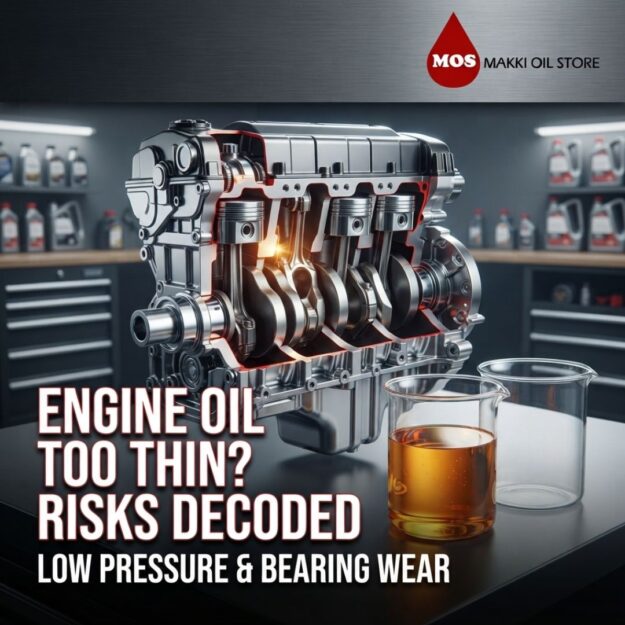
Engine Oil Becomes Too Thin

What Happens If Engine Oil Becomes Too Thin?

Every engine requires a precise balance of fluid viscosity to operate smoothly under varying thermal loads. When a lubricant loses its structural body or breaks down under intense operating conditions, it fails to maintain the necessary cushioning between fast-moving metal parts. Using or running on thin engine oil past its operational threshold can compromise internal…
Car Smell Like Burning Oil

Why Does My Car Smell Like Burning Oil?

Detecting an unusual odor inside or outside your vehicle can be an unsettling experience for any driver. When a distinct, acrid scent begins to drift through the cabin or wafts out from under the hood after a drive, it is usually a clear sign that something is amiss. A burning smell is never something to…

Causes Engine Noise

What Causes Engine Noise After an Oil Change?

An oil change is supposed to make your vehicle run smoother, quieter, and more efficiently. Hearing a strange ticking, tapping, or knocking sound immediately after driving away from a service bay can be deeply concerning. Finding out causes of engine noise after an oil change requires looking at mechanical factors like incorrect fluid levels, unprimed…

Engine Oil Level

Why Does Engine Oil Level Drop After a Few Days?

Checking your vehicle’s dipstick a few days after an oil change and discovering that the fluid line has dropped can be deeply unsettling. Many drivers immediately assume the worst, fearing a catastrophic internal leak or a cracked engine block. However, a slight drop right after a service is often due to normal mechanical settling rather…

Engine Oil Turning

Why Is My Engine Oil Turning Black So Quickly?

Pulling out your car’s dipstick during a routine check and finding pitch-black fluid can cause immediate alarm for many vehicle owners. A common misconception is that dark or black lubricant automatically signals a failing engine or an immediate emergency. In reality, a color change is often a natural part of an oil’s normal operational cycle.…

Choosing Engine Oil

What Drivers Should Know Before Choosing Engine Oil

Navigating the automotive lubricant market can often feel overwhelming for vehicle owners. With countless options lining retail shelves, selecting the right fluid for your car is one of the most consequential maintenance decisions you will ever make. When choosing engine oil, many drivers rely solely on brand familiarity or historical habits, ignoring the specific chemical…

Engine Oil Changes

How Engine Oil Changes with Heat, Dust, and Traffic

When you read a product manual, it often outlines service intervals based on ideal driving conditions: empty highways, moderate weather, and clean air. However, driving daily in Pakistan introduces an entirely different set of environmental stressors. High ambient temperatures, severe traffic congestion, and heavy airborne dust act as harsh catalysts that accelerate how quickly engine…

Wrong Oil Grade

Why Using the Wrong Oil Grade Can Affect Engine Performance

Every vehicle manufacturer designs an engine with exact specifications, tolerances, and mechanical clearances in mind. When you turn your key, the lubricant flowing through the internal galleries does much more than simply prevent metal-on-metal friction; it acts as a hydraulic fluid that dictates how efficiently your motor functions. Choosing an incorrect viscosity grade can quietly…

5W30, 10W40, and 20W50

What Do 5W30, 10W40, and 20W50 Mean?

When you open the hood of your car or read through your vehicle’s maintenance manual, you will inevitably encounter a set of numbers and letters used to describe engine oil. Codes like 5W30, 10W40, and 20W50 often look like a complex mathematical formula to the average driver. However, understanding what these multi-grade ratings mean is…