


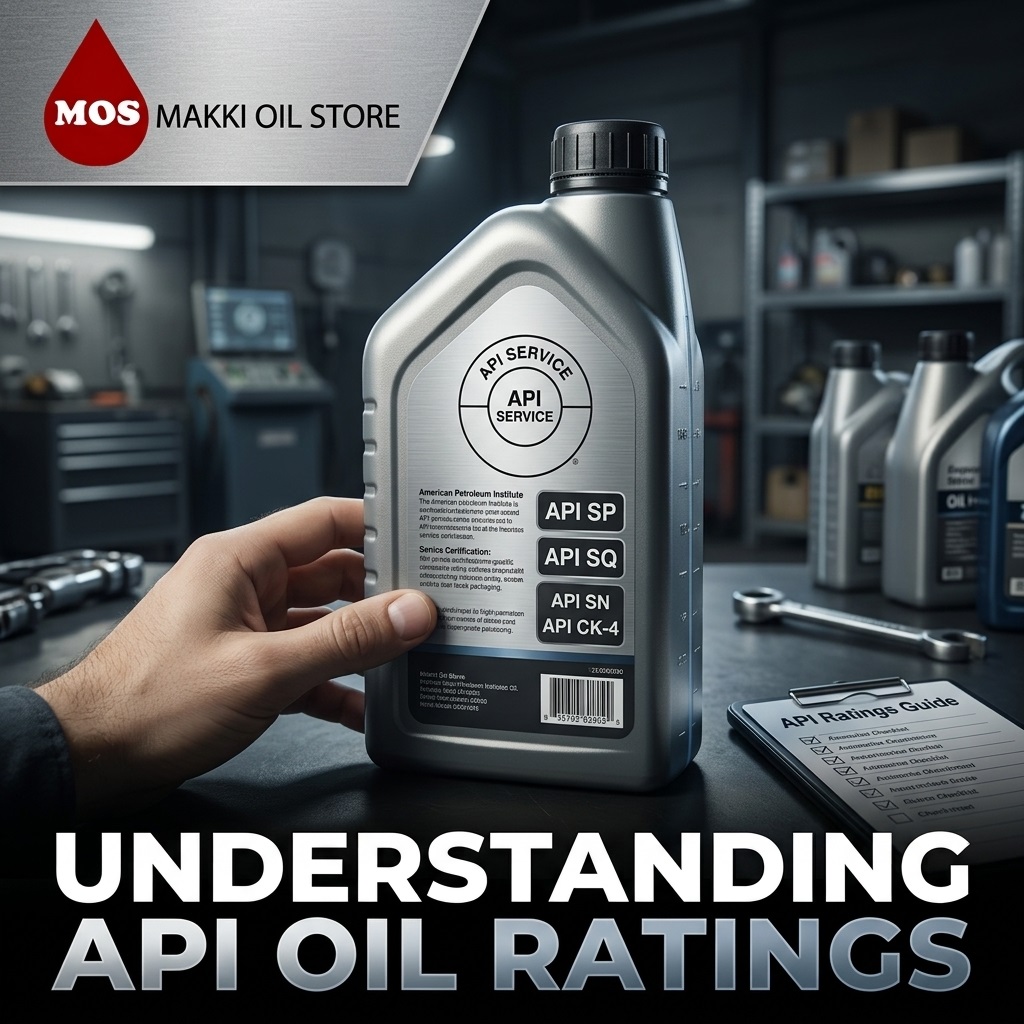
When you pick up a bottle of motor oil in a Pakistani auto parts shop, you will see viscosity numbers like 5W-30 or 20W-50 right next to codes such as API SP, API SN, or API CK-4. Many drivers focus almost entirely on viscosity and brand name while skipping the API oil rating printed on the back or side label. Yet those letters tell you something viscosity alone cannot: whether the lubricant’s chemical additive package meets current performance and engine protection standards for your specific type of engine.
In cities like Lahore, Karachi, and Islamabad where summer heat climbs past forty degrees Celsius, traffic crawls for hours, and fuel quality can vary picking the right API specification protects pistons, timing chains, turbochargers, and emission hardware from premature wear.
What API Stands For and How Service Categories Work
API stands for the American Petroleum Institute. Through its Engine Oil Licensing and Certification System, API defines performance standards for motor oils based on testing for oxidation resistance, deposit control, wear protection, and emission-system compatibility.
Notice the distinction between viscosity and API service categories. An SAE viscosity grade such as 0W-20, 5W-30, or 15W-40 describes how thick or thin the oil flows across temperature ranges. An API category describes how well the oil resists breakdown and protects internal components under real operating stress. Two different 5W-30 oils can carry very different API ratings and serve very different engines.
Drivers who want a broader look at how viscosity codes, synthetic labels, and other markings fit together on a container can check how to read engine oil labels without confusion before buying their next service pack.
Gasoline Engines: API “S” Categories
For spark-ignition petrol and gasoline engines, API uses the letter “S” followed by a second letter that advances alphabetically as standards evolve. Later letters generally represent newer specifications with stricter performance tests.
- API SQ: Introduced in March 2025 as the latest gasoline category, addressing fresh- and aged-oil low-speed pre-ignition (LSPI), timing-chain wear, high-temperature piston and turbocharger deposits, and sludge control.
- API SP: Introduced in May 2020 with strong protection against LSPI in turbocharged direct-injection engines, timing-chain wear, high-temperature deposits, and varnish.
- API SN: An earlier gasoline standard still relevant where specified for older engines, covering high-temperature piston deposit control, sludge resistance, and seal compatibility.
- Older “S” Codes (SL, SJ, SH, SG, and earlier): Older classifications tied to earlier vehicle eras, with many early letter codes considered obsolete for modern engines.
Diesel Engines: API “C” and “F” Categories
For compression-ignition diesel engines, API uses “C” (commercial) categories such as CK-4, CJ-4, CI-4, and CH-4 alongside specialized “F” categories like FA-4 for select modern low-viscosity diesel applications. Diesel oils are engineered to handle high combustion pressures, heavy soot loads, oxidation, and exhaust aftertreatment requirements.
Some oils carry dual ratings (such as a C category paired with an S category), while others are strictly formulated for one engine family. Always check your vehicle owner manual rather than assuming every dual-rated or heavy-duty oil suits every car.
| API Code | Primary Engine Type | Status / Context | Key Protection Focus |
| API SQ | Gasoline / Petrol | Current (introduced 2025) | Aged-oil LSPI, timing-chain wear, deposits, sludge |
| API SP | Gasoline / Petrol | Current (introduced 2020) | LSPI, timing-chain wear, turbo/piston deposits, sludge |
| API SN | Gasoline / Petrol | Current for older specs | Piston deposit control, sludge resistance, seal compatibility |
| API CK-4 | Diesel (Heavy-Duty / 4-Stroke) | Current | Oxidation, shear stability, soot viscosity control, wear |
Reading the API Donut and Why Local Conditions Matter
Many licensed lubricants display the circular API Service Symbol commonly called the “Donut”. The top ring shows the API performance category, the center displays the SAE viscosity grade, and the bottom ring notes extra designations such as “Resource Conserving” when applicable.
In Pakistan’s driving environment, API performance ratings carry practical weight. Prolonged idling in heavy traffic, high ambient heat, and dust exposure accelerate oil oxidation and deposit formation. Modern turbocharged small-displacement petrol engines, for example, benefit from current “S” specifications designed to resist low-speed pre-ignition and high-temperature turbo coking. Meanwhile, diesel owners must pay close attention to both the API rating and diesel fuel sulfur levels, as manufacturer manuals often specify interval adjustments when fuel sulfur exceeds low-sulfur thresholds.
When it is time to drain old oil and install fresh lubricant matched to your engine’s specification, booking a proper change through service engine oil helps keep internal wear under control.
Choosing the Right Specification Without Guesswork
A common mistake among motorists is assuming that “newer is always better” for every vehicle. While newer gasoline API categories like SP or SQ are generally backward compatible with many older petrol engines that called for earlier “S” ratings, certain older or specialty engines such as classic flat-tappet designs or specific diesel configurations have particular additive or fuel-compatibility requirements. Checking your owner manual first saves money and prevents mismatched chemistry.
For drivers looking for broader vehicle upkeep alongside lubrication such as filter replacements, fluid checks, and diagnostic inspections reviewing our services shows how routine maintenance works together across the car.
If you prefer visiting a physical shop to check oil grades and pick up sealed containers in person, locating a nearby workshop via branches makes planning simple.
At the Makki Oil Store, our team helps drivers match genuine, properly rated lubricants to their vehicle’s manual and everyday driving demands across Pakistan.
Frequently Asked Questions
What does “S” vs. “C” mean in an API oil rating?
In API service categories, “S” stands for service (spark-ignition gasoline or petrol engines) and “C” stands for commercial (compression-ignition diesel engines).
Is API SP better than API SN for a gasoline car?
API SP is a newer gasoline specification introduced in 2020 that adds stronger protection against low-speed pre-ignition and timing-chain wear alongside high-temperature deposit and sludge control. Always confirm your vehicle manual to verify compatibility.
What is API SQ and when was it introduced?
API SQ is a current gasoline engine oil category introduced in March 2025, updating performance requirements for low-speed pre-ignition (including aged oil), timing-chain wear, high-temperature deposits, and sludge control.
Can I use a diesel API oil in a petrol car?
Do not use a diesel-only “C” rated oil in a petrol engine unless your manufacturer approves it or the oil carries a valid rating for your gasoline engine. Diesel formulations have different additive balances suited to compression engines and soot control.
Does a higher API rating extend my oil change interval?
A higher API rating improves thermal stability, deposit control, and wear protection, but your actual oil change interval should still follow your manufacturer’s schedule and be shortened when driving in severe heat, heavy traffic, or dusty conditions.