Checking your vehicle’s dipstick a few days after an oil change and discovering that the fluid line has dropped can be deeply unsettling. Many drivers immediately assume the worst, fearing a catastrophic internal leak or a cracked engine block. However, a slight drop right after a service is often due to normal mechanical settling rather than a sudden emergency. Understanding why your engine oil level fluctuates during the first few days of operation helps you differentiate between standard mechanical behavior and genuine consumption issues.
The Science of Initial Gallery Filling
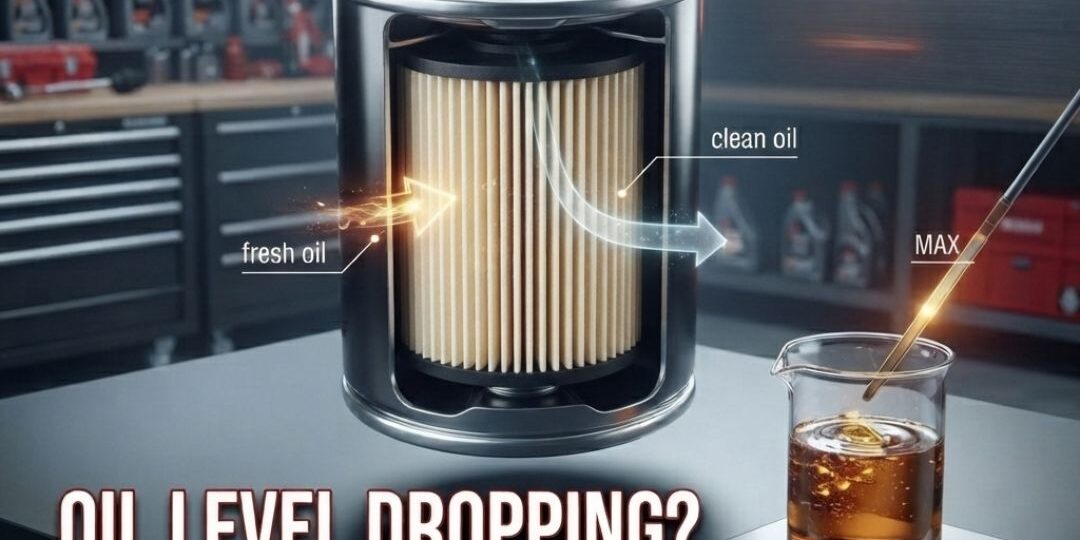
When an engine undergoes a complete oil service, the fresh lubricant is poured directly into the valve cover or oil filler hole, filling the oil pan below. However, the moment you start the engine for the first time, the oil pump immediately forces fluid upward into empty internal pathways. This includes filling the oil filter housing, hydraulic valve lifters, variable valve timing actuators, turbocharger lines, and upper cylinder galleries.
Because a significant volume of oil is permanently sequestered throughout these internal channels while the engine runs, the overall level visible on the dipstick will drop slightly once the system has cycled and settled. To ensure you are tracking your fluid levels accurately and consistently under proper conditions, you can follow a clear, practical guide on how to check your engine oil level at home to eliminate measurement errors. Taking accurate readings on a level surface with a cooled engine ensures you never misinterpret normal gallery filling as a leak.
Real-World Driving Pressures in Local Conditions
Beyond initial mechanical settling, environmental stressors can also influence how your vehicle consumes lubricants over time. In demanding driving landscapes like those found across Pakistan, high ambient summer temperatures and severe stop-and-go traffic congestion increase internal thermal loads. If the oil thins out excessively under high heat, it can slip past worn piston rings or valve stem seals more readily, leading to actual consumption rather than just distribution settling.
At the Makki Oil Store, we frequently assist motorists who mistake normal filter absorption and gallery priming for a major oil leak. Maintaining a proactive approach to fluid checks during the first week following a service ensures peace of mind. By keeping a close eye on your dipstick and using high-grade lubricants suited to your engine’s design, you protect your vehicle against unexpected drops and maintain stable pressure across all internal components.
Frequently Asked Questions
Why does the oil level drop immediately after a fresh oil change?
The oil level often drops slightly during the first few days after an oil change because the fresh fluid has to fill up all the empty internal components of the engine. When the technician pours new oil into the engine, it mostly pools in the oil pan. As soon as you start the car, the oil pump circulates that fluid upward to fill the oil filter canister, hydraulic lifters, timing chain tensioners, and upper valve train galleries. Once the engine is turned off and the oil settles back down, some fluid remains trapped inside these components, causing the dipstick reading to be slightly lower than the initial fill level.
Is it normal for an engine to consume a small amount of oil?
Yes, a minor amount of oil consumption is considered completely normal by almost all vehicle manufacturers. Engines rely on a thin microscopic film of oil on the cylinder walls to lubricate the moving piston rings, and a tiny fraction of this oil is naturally exposed to combustion temperatures and burned off during the normal power stroke. While modern, well-maintained engines consume very little between standard service intervals, higher-mileage motors or vehicles operating under severe conditions may experience slightly higher consumption rates that require periodic top-ups.
How can I tell the difference between normal gallery filling and a real oil leak?
You can differentiate between normal fluid settling and an actual leak by inspecting your parking spot and checking the engine bay for physical pooling. If your dipstick drops slightly over the first two days and then stabilizes completely without any puddles forming underneath the car, it is simply internal gallery priming and filter saturation. However, if the oil level continues to drop steadily day after day accompanied by fresh wet spots on the ground or oily residue clinging to the bottom of the engine block, you are dealing with an active external leak that requires professional mechanical inspection.
Can using the wrong oil viscosity cause rapid oil level drops?
Using an incorrect or overly thin oil viscosity can significantly increase oil consumption and cause the fluid level to drop rapidly. If the oil is too thin for your engine’s specific mechanical tolerances, it fails to maintain an adequate seal around worn piston rings or valve guides, allowing excess fluid to slip past into the combustion chambers where it is burned away. Furthermore, thin oil can leak past aging gaskets and seals more easily under high operating pressures, accelerating the rate at which fluid disappears from the system.
What steps should I take if my engine oil level keeps dropping continuously?
If your engine oil level continues to drop persistently past the initial settling phase, you should begin a systematic diagnostic check. First, look underneath the vehicle for any signs of dripping oil, paying close attention to the drain plug, oil filter gasket, and valve cover seals. Next, inspect your exhaust tailpipe for blue or gray smoke, which indicates that oil is burning inside the combustion chambers due to worn piston rings or valve stem seals. If no external leaks are visible and consumption persists, consult a trusted mechanic to perform a compression and leak-down test on the engine.