Operating a vehicle in Pakistan involves navigating an incredibly diverse driving landscape. A standard commuter vehicle might cope with freezing winter mornings in northern mountain regions and then face blistering summer heat waves exceeding 45°C in central Punjab plains. In urban financial hubs like Lahore and Karachi, stop-and-go gridlock keeps internal combustion engines idling for hours without structural cooling airflow.
To survive these environmental and operational challenges, your car relies completely on its internal lubrication layer. However, walking into a parts market presents a confusing wall of options featuring complex numeric sequences and letters. Understanding the core mechanics behind engine oil viscosity ratings is the most effective way to protect your powertrain from premature wear, maintain maximum fuel economy, and avoid catastrophic mechanical breakdown.
Understanding Viscosity and the SAE Scale
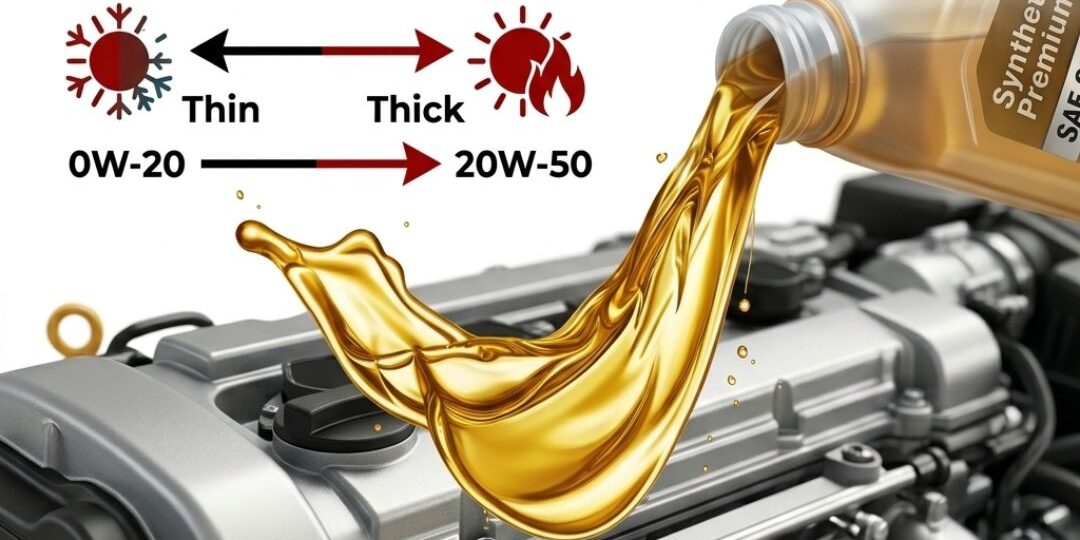
In simple terms, viscosity refers to a fluid’s internal resistance to flow. A high-viscosity fluid behaves like molasses, moving slowly and forming a thick physical barrier, while a low-viscosity fluid behaves more like water, flowing rapidly with minimal resistance. Inside a car engine, this fluid layer must change dynamically. It must remain thin enough to circulate instantly during a freezing cold morning start, yet stay thick enough under intense combustion heat to prevent moving metal components from scraping together.
Modern automotive lubricants are classified as multi-grade fluids, meaning they are chemically formulated to alter their behavior across a broad temperature scale. These fluids are marked using a standardized coding system created by the Society of Automotive Engineers (SAE), such as 5W-30 or 20W-50.
[ 5W ] – [ 30 ]
| |
Cold-Start Flow Rating High-Temperature Thickness
(Lower = Faster Winter Flow) (Higher = Better Heat Defense)
The numeric value preceding the letter “W” (which stands for Winter) denotes the fluid’s cold-flow capabilities. A lower winter rating, like 0W or 5W, means the fluid stays thin and highly fluid at low temperatures, allowing the oil pump to push it to the top valvetrain within milliseconds of turning the key.
The second numeric value, located after the hyphen, represents the fluid’s kinematic viscosity when the engine reaches its standard operating temperature ($100^\circ\text{C}$). A higher trailing number indicates a thicker oil film that resists thinning out under immense thermal stress.
Choosing Between Low and High Viscosity Grades
Automotive engineering has shifted significantly over the past two decades, leading to a major divide in how modern and legacy powertrains use lubrication.
The Mechanics of Low-Viscosity Formulations (e.g., 0W-20, 5W-30)
Modern engines built by Japanese and European manufacturers feature incredibly tight, microscopic mechanical clearances between moving parts. These advanced powerplants are designed to use thin, low-viscosity fluids.
A thinner fluid pumps effortlessly through narrow oil galleys, reducing internal parasitic drag on the pistons. This allows the engine to spin more freely, resulting in quick oil pressure delivery at startup, lower carbon emissions, and excellent fuel economy.
The Mechanics of High-Viscosity Formulations (e.g., 10W-40, 20W-50)
Older vehicle engines, or high-mileage powerplants that have experienced years of mechanical wear, feature much wider physical clearances between internal bearings and cylinder walls. These engines require a thick, high-viscosity lubricant to bridge the physical gaps.
A heavier fluid provides a structural cushion that absorbs mechanical shock, dampens valvetrain noise, and creates an effective seal around aging piston rings. This prevents oil from slipping past the seals into the combustion chamber, reducing overall oil consumption.
Aligning Your Choice with Vehicle Needs and Driving Conditions
Selecting the correct lubricant involves balancing your vehicle’s factory engineering rules with your daily driving environment.
Relying on Factory Engineering Profiles
The primary authority for any fluid selection is your vehicle’s factory owner’s manual. Automobile manufacturers spend thousands of hours testing engine blocks to determine the precise fluid dynamics needed for their oil pumps and variable valve timing (VVT) gearmaps. Using a heavy fluid in a system built for thin oil can slow down oil delivery, causing starvation and premature wear on overhead cams.
To help you match these technical requirements to your vehicle’s specific design, it is highly useful to learn how to choose the right Makki engine oil for your specific car type before your next scheduled maintenance.
Factoring in Mileage and Local Climate
While sticking to factory recommendations is best for new vehicles, real-world wear requires adjustments over time. If a vehicle has driven over 150,000 kilometers and is beginning to burn fluid or blow faint blue smoke during acceleration, moving up slightly to a more robust viscosity grade can help seal worn clearances.
Additionally, drivers operating heavy transport utilities or older vehicles in high-heat regions like Sindh and southern Punjab often benefit from a step up in high-temperature viscosity to prevent the oil film from shearing under heavy loads.
The Hazards of Incorrect Viscosity Application
Pouring an incorrect fluid grade into your crankcase can lead to noticeable drops in performance and hidden mechanical degradation.
The Consequences of Overly Thick Fluid
- Delayed Startup Circulation: The majority of engine wear happens during the first 60 seconds after a cold start. An overly thick oil takes too long to reach the cylinder head, causing dry metal-on-metal friction.
- Reduced Fuel Efficiency: A heavy fluid increases internal fluid drag, forcing the engine to consume more fuel just to turn the crankshaft.
- VVT Operational Lag: Modern variable valve timing systems rely on rapid hydraulic oil pressure to adjust camshaft positions. Thick oil causes sluggish pressure response, resulting in poor throttle timing and check engine lights.
The Consequences of Overly Thin Fluid
- Thermal Film Failure: Under high operating temperatures, an overly thin oil can break down completely, leaving bearing surfaces unprotected.
- Excessive Oil Consumption: Thin fluid easily slips past worn valve guides and piston rings, burning up in the combustion chamber and leaving heavy carbon crusts behind.
- Accelerated Mechanical Wear: Without a proper physical barrier, internal metal components rub together, causing accelerated wear on lifters and bearings.
Ensuring Authentic Sourcing for Maximum Protection
Even the most accurate viscosity selection will fail to protect your engine if the fluid itself is counterfeit or sub-grade. The Pakistani automotive market contains a significant amount of repackaged or low-quality bulk oils sold in cloned packaging. These imitation fluids lack critical anti-wear additives and thermal stabilizers, meaning they quickly break down into a thick, destructive sludge inside your engine.
| Lubricant Type | Base Composition | Ideal Operating Profile |
| Fully Synthetic | Chemically altered artificial bases | Maximum thermal stability, long drain intervals, excellent cold-flow performance. |
| Semi-Synthetic | Engineered blend of mineral and synthetic bases | Balanced multi-valve protection and robust oxidation resistance for daily city driving. |
| Conventional Mineral | Refined crude petroleum | Robust, heavy-film boundary sealing tailored for vintage or high-mileage engines. |
To safeguard your vehicle, source your lubricants from an organized, highly professional provider. Partnering with a certified regional center like the Makki Oil Store ensures you receive direct access to genuine, factory-sealed products from leading international brands. This professional approach protects your engine investment, keeping your daily drives safe, smooth, and efficient.
Frequently Asked Questions
What does the “API” service symbol on an engine oil container mean?
The API (American Petroleum Institute) service symbol is an official quality stamp that indicates the fluid meets strict global performance and environmental safety standards. The rating is displayed as a two-letter code, such as API SP. The letter “S” stands for Service or Spark-ignition, meaning it is designed for gasoline engines, while the second letter indicates the advancement of the additive package, with “P” being the current standard for modern turbocharged engines.
Can I switch from a conventional mineral oil to a fully synthetic oil in an older car?
Yes, you can safely switch to a fully synthetic fluid in an older vehicle, but it requires a careful approach. Synthetic oils contain highly effective cleaning detergents that sweep away old sludge deposits inside the engine. In an older engine, that built-up sludge might be the only thing sealing tiny cracks in worn rubber gaskets. Once the synthetic oil cleans the sludge away, those old gaskets may begin to weep or leak fluid externally.
Why does my car engine oil look completely black on the dipstick after only a few weeks?
Seeing your lubricant turn dark black is actually a sign that the fluid is successfully doing its job. High-quality oils are formulated with advanced dispersant and detergent additives designed to clean the engine’s internal walls. They scrub away carbon soot and microscopic combustion byproducts, holding them safely in suspension so they cannot form thick sludge deposits on your internal engine components.
How does driving in continuous stop-and-go traffic alter my oil viscosity needs?
Idling for long periods in dense city traffic jams generates intense internal heat with zero cooling airflow passing through the front radiator. This extreme environment accelerates oil oxidation and thermal breakdown much faster than driving open kilometers on a highway. If you regularly commute through heavy urban gridlock, you should shorten your service intervals to replace the fluid before it thins out and loses its protective capability.
What is the risk of using a multi-grade oil that has a very wide viscosity spread like 10W-60?
Lubricants with an exceptionally wide viscosity spread require a high concentration of chemical polymers called Viscosity Index Improvers (VIIs). While these polymers allow the fluid to stay thick under extreme heat, they are susceptible to mechanical shearing under heavy stress. Over extended intervals, these polymers can break down, causing the oil to lose its high-temperature thickness and drop down to a much thinner grade.