Navigating the bustling traffic of Lahore, from the tight lanes of Gulberg to the expansive lanes of the Ring Road, places tremendous strain on your car. Local driving conditions defined by intense summer heat, frequent stop-and-go gridlock, and airborne dust require your vehicle’s engine to work twice as hard to maintain peak efficiency. At the heart of your engine’s survival is its lubrication system.
Unfortunately, many drivers inadvertently reduce their vehicle’s lifespan by falling into bad maintenance habits. Using the wrong fluid or skipping routine checks can cause quiet, internal wear that eventually leads to catastrophic engine failure. Understanding the most common engine oil mistakes can save you from unexpected vehicle breakdowns and thousands of rupees in preventable workshop repairs.
1. Delaying Scheduled Maintenance Intervals
Waiting too long between service intervals is one of the quickest ways to degrade an engine. Lubricants are formulated with complex chemical additives designed to combat friction, neutralize acids, and keep internal components clean. Over thousands of kilometers, exposure to extreme heat and mechanical stress naturally breaks down these additives.
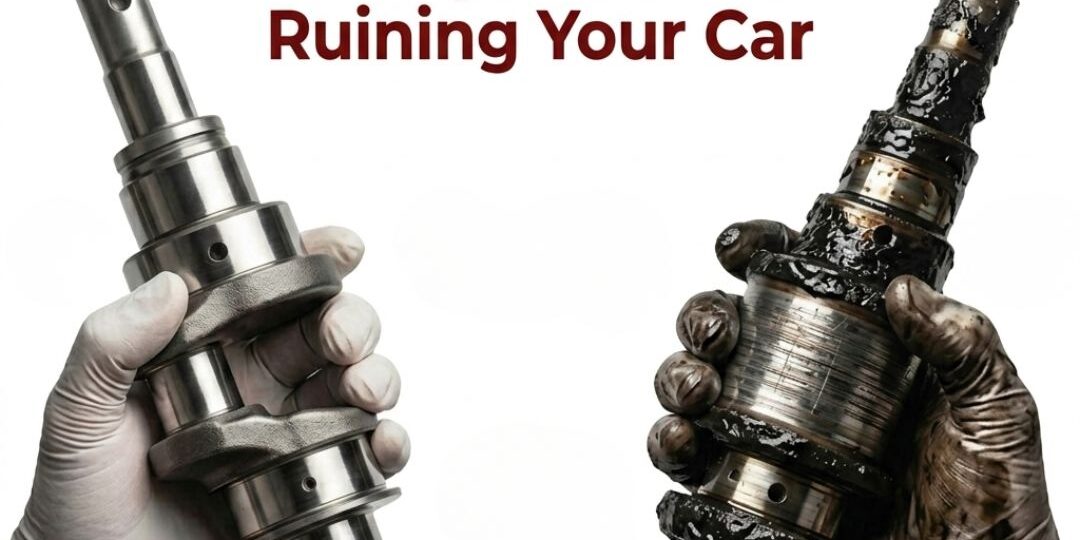
When fluid remains in the crankcase past its operational life, it loses its protective properties and transforms into a thick, abrasive black sludge. This sludge blocks critical oil passages and starves sensitive components like camshafts and lifters. In severe cases, the oil pump can no longer circulate the thick fluid, leading to direct metal-on-metal contact, scorched bearings, and a completely seized engine block.
2. Using the Incorrect Viscosity Rating
An engine is engineered to operate within highly specific clearances. The vehicle manufacturer selects an explicit viscosity grade (such as 0W-20, 5W-30, or 20W-50) to ensure the fluid flows quickly during cold starts while maintaining a durable protective film at high operating temperatures.
Ignoring your owner’s manual and selecting an incorrect viscosity can cause long-term mechanical damage:
- Viscosity Too Thin: If you use a thin fluid in an engine designed for a heavier grade, the oil film can tear under high thermal loads. This leads to accelerated wear on piston rings and cylinder walls.
- Viscosity Too Thick: Using an overly thick fluid in a modern, tight-tolerance engine prevents the lubricant from circulating rapidly during initial startup. This leaves critical valvetrain components temporarily unprotected.
3. Mixing Incompatible Chemical Formulations
When your dipstick shows a low fluid level, it can be tempting to grab whatever bottle is closest to top off the reservoir. However, combining fluids with different base chemical properties or drastically different additive packages can compromise your engine’s safety.
To preserve the complex chemical balance inside your crankcase, it is highly useful to learn how mixing engine oils can turn into a costly mistake before blending different fluid brands or chemical types. Mixing standard mineral products with advanced synthetic formulations can destabilize the anti-wear chemistry, causing the fluid to lose its protective capability much faster than expected.
4. Driving with Low or Excess Fluid Levels
Operating a vehicle with the incorrect amount of lubricant whether too low or significantly overfilled creates severe mechanical issues inside the crankcase.
| Oil Level Status | Primary Mechanical Impact | Long-Term Consequence |
| Severely Low | Rapid heat accumulation and severe component friction | Total bearing failure and warped internal components |
| Significantly Overfilled | Crankshaft whips fluid into an aerated, bubbly foam | Loss of oil pressure and ruptured engine oil seals |
When the fluid level drops below the minimum indicator mark, the remaining oil undergoes immense thermal stress because there is less volume to distribute the engine’s intense heat. Conversely, overfilling causes the spinning crankshaft to strike the fluid pool, whipping it into a thick foam. Because your oil pump cannot effectively pressurize an aerated fluid, internal oil pressure drops, leaving vital components unprotected.
5. Neglecting the Engine Oil Filter Replacement
An engine filter traps microscopic carbon particles, fine metallic debris, and road dust suspended within the moving fluid. To save a minimal amount during maintenance, some drivers make the mistake of changing their filter only every second or third service cycle.
Leaving a contaminated filter in place quickly ruins fresh fluid. Once a filter element becomes completely saturated with debris, a built-in safety bypass valve opens to prevent total oil starvation. This allows raw, un-filtered dirt to circulate directly back through your engine, causing microscopic scratches on polished bearing journals and piston rings.
By visiting a highly reputable automotive service center like the Makki Oil Store, you ensure your vehicle receives direct access to authentic, certified lubricants and premium replacement filters. Professional technicians handle your maintenance using proper equipment, keeping your vehicle running smoothly, efficiently, and safely for years to come.
Frequently Asked Questions
Can I rely entirely on my car’s electronic dashboard oil life monitor?
While modern electronic oil life monitors provide helpful estimates by tracking engine revolutions and operating temperatures, they cannot actively measure physical fluid volume or contamination. These systems will not alert you if a road hazard punctures your oil pan or causes a sudden drop in fluid levels. You should still manually check your dipstick at least once every two weeks to verify actual fluid volume and clarity.
Why does my engine burn oil faster during long highway trips at high speeds?
Sustained high-speed highway driving increases engine operating temperatures and forces the oil pump to maintain high pressures. This extreme thermal load causes a fraction of the engine oil to naturalize into microscopic vapors through a process called evaporation loss. If your engine has slightly worn valve stem seals or piston rings, the thin oil vapors pass into the combustion chamber much easier, leading to higher consumption than normal city commuting.
What is the difference between API service classifications like SP and older ratings?
The American Petroleum Institute (American Petroleum Institute) periodically updates its service categories to protect advanced engine designs. The API SP standard is specifically formulated to safeguard modern turbocharged, direct-injection engines from low-speed pre-ignition (LSPI), an abnormal combustion phenomenon that can crack pistons. Older classifications lack the advanced chemistry needed to manage these high-pressure loads safely.
How does driving short distances in cold weather degrade my engine oil?
When a vehicle is driven only short distances (less than 10 kilometers), the engine never reaches its optimal operating temperature ($100^\circ\text{C}$). As a result, the moisture condensation and raw fuel vapors that naturally bypass the piston rings cannot evaporate out of the crankcase. This accumulates moisture over time, diluting the protective lubricant layer and accelerating acid formation that corrodes internal bearings.
Is dark black oil on the dipstick an immediate sign that the fluid has failed?
Not necessarily. High-quality lubricants contain powerful detergent additives designed to clean the inside of your engine by scrubbing away carbon soot and keeping it suspended safely in the fluid. Seeing amber fluid turn dark black indicates the oil is successfully doing its cleaning job. However, if the dark oil feels distinctly gritty between your fingertips, smells burnt, or has been in use past your service interval, it requires an immediate change.