

Walking down the lubricant aisle of any automotive shop in Pakistan presents an immediate pricing dilemma. On one shelf sits a jug of semi-synthetic motor oil at an accessible price point, while right next to it sits a fully synthetic bottle carrying a noticeably higher price tag. For daily commuters navigating congested city traffic, commercial fleet operators managing tight budgets, and car enthusiasts seeking maximum engine longevity, choosing between synthetic vs semi-synthetic oil raises an important practical question: does the higher upfront expense of full synthetic actually deliver measurable value, or is a synthetic blend good enough for everyday driving?
Understanding how these two lubricant categories are engineered at a molecular level and how they perform under Pakistan’s punishing summer heat and stop-and-go gridlock reveals exactly where your money goes and which option makes financial sense for your vehicle.
Base Stock Engineering: How Both Oils Are Formulated
The fundamental difference between these two lubricant types lies in the origin and purity of their base oils before chemical additive packages are blended in.
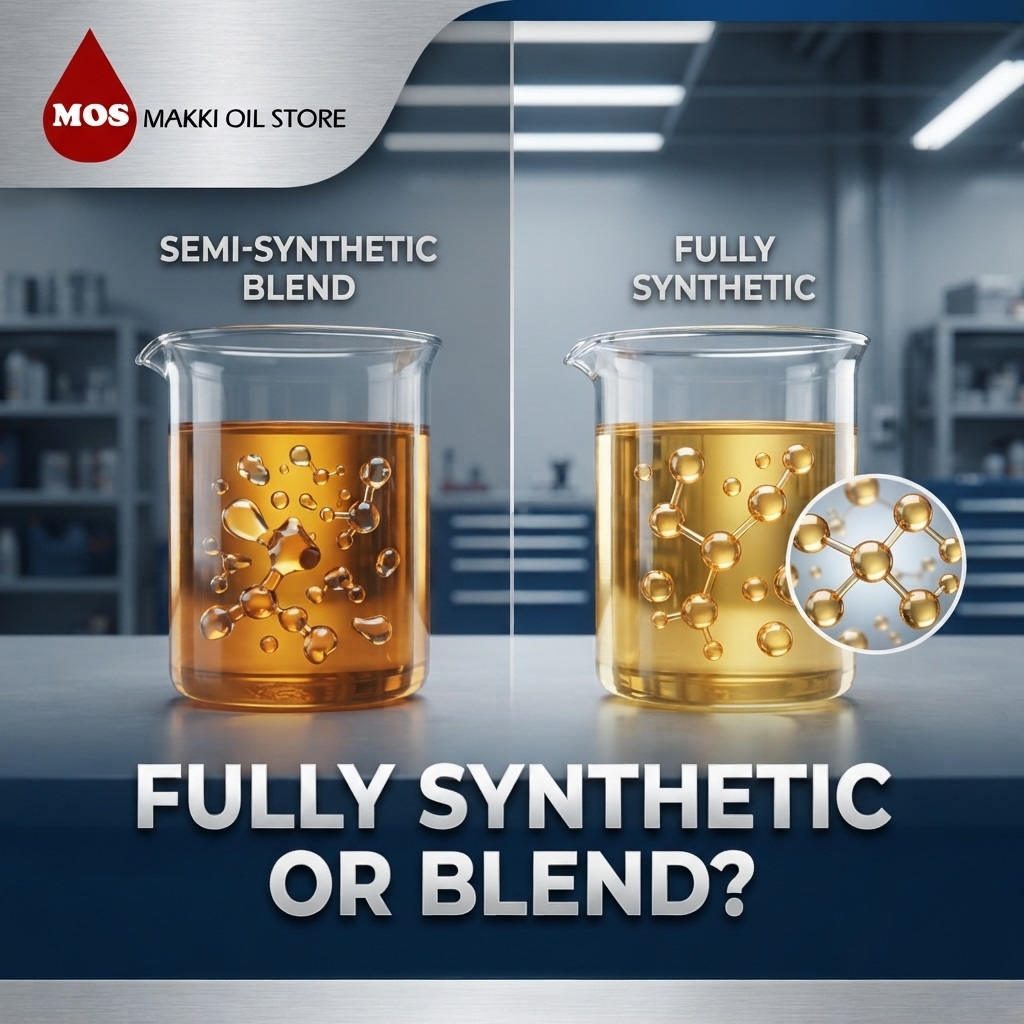
Semi-synthetic oil, often marketed as a synthetic blend, combines conventional mineral oil refined directly from crude petroleum with a measured percentage of chemically engineered synthetic base stocks (typically ranging between 15% and 30%). Because conventional mineral oil contains molecules of irregular shapes and sizes alongside trace impurities like sulfur and wax, a blend inherits both the affordability of mineral oil and a portion of the thermal stability offered by synthetics.
Fully synthetic oil, by contrast, contains zero conventional mineral base stocks. Instead, engineers synthesize uniform hydrocarbon molecules from scratch using advanced chemical processes such as hydrocracking or polyalphaolefin (PAO) synthesis. Every molecule is uniform in size and structure, completely free of naturally occurring petroleum impurities. To see how these molecular structures dictate real-world lubrication performance, drivers can review technical comparisons detailing what is the difference between synthetic oil and synthetic blends to understand how base stock purity affects engine wear.
Performance Under Pakistani Driving Conditions
Driving conditions across Lahore, Karachi, Islamabad, and regional highways subject motor oils to extreme thermal and mechanical stress. Ambient summer temperatures routinely climb past forty degrees Celsius, while dense urban traffic forces engines to idle for extended periods with minimal airflow across the radiator.
Under intense heat, the irregular molecules in conventional and semi-synthetic oils oxidize and shear apart faster. As the oil thins out or forms sticky varnish deposits, internal friction rises. Fully synthetic lubricants resist thermal breakdown remarkably well, maintaining consistent viscosity and a durable protective film even when engine bay temperatures soar during peak summer traffic jams.
| Performance Factor | Semi-Synthetic Oil (Blend) | Fully Synthetic Oil |
| Base Stock Composition | 70–85% refined mineral oil + 15–30% synthetic | 100% chemically engineered uniform base stocks |
| High-Temperature Stability | Moderate resistance to oxidation and thinning | Superior resistance to heat shear and thermal breakdown |
| Cold-Start Flow | Good flow in mild winters | Instantaneous circulation during cold mornings |
| Sludge and Deposit Control | Standard detergent protection | Maximum resistance to varnish and carbon sludge |
| Typical Change Interval | 5,000 to 6,000 kilometers | 8,000 to 10,000 kilometers |
Evaluating Long-Term Cost vs. Value
At the register, fully synthetic oil typically costs thirty to fifty percent more per liter than a comparable semi-synthetic blend. However, calculating true ownership cost requires looking beyond the initial purchase price to evaluate service intervals, fuel efficiency, and long-term engine preservation.
- Extended Drain Intervals: Because synthetic base stocks resist chemical degradation and additive depletion far longer, you can safely drive nearly double the mileage between oil changes compared to a blend. Over 20,000 kilometers, two synthetic oil changes often cost the same or less than four semi-synthetic oil and filter replacements, while saving you repeated workshop visits.
- Reduced Parasitic Friction and Fuel Savings: Uniform synthetic molecules glide past one another with minimal internal fluid drag. This reduced friction allows engine components to spin more freely, delivering a measurable two to four percent improvement in fuel economy during daily commuting.
- Turbocharger and Precision Engine Protection: Modern vehicles equipped with turbochargers, direct fuel injection, and variable valve timing run hotter and tighter than older engines. High-speed turbine bearings reach extreme temperatures where mineral components inside a blend can bake into solid carbon deposits, starving the turbo of oil.
Car owners weighing how synthetic formulations compare against traditional petroleum lubricants across various engine ages can explore broader selection criteria in our guide on synthetic vs conventional engine oil which is the best engine oil in Pakistan to match lubricant technology with their vehicle’s mechanical design.
Which Oil Should You Choose for Your Vehicle?
Making the right selection comes down to your vehicle’s engineering requirements, mileage, and daily driving habits.
- Choose Fully Synthetic Oil If: You drive a modern sedan, hybrid, SUV, or turbocharged vehicle; your owner manual specifies low-viscosity grades like 0W-20 or 5W-30; you frequently sit in heavy urban traffic gridlock; or you want maximum protection across extended service intervals.
- Choose Semi-Synthetic Oil If: You drive an older, naturally aspirated economy car with standard tolerances that specifies 10W-30 or 10W-40; you drive short distances with light loads; or you prefer adhering to strict 5,000-kilometer maintenance intervals on a tighter upfront budget.
Drivers seeking professional fluid consultations, genuine filter replacements, and multi-point vehicle inspections can explore complete maintenance packages through our services to ensure their powertrain stays protected year-round.
For motorists looking for convenient, trustworthy service centers stocked with authentic factory-sealed lubricants, locating nearby workshops via branches makes scheduling your next oil change effortless.
At the Makki Oil Store, our automotive specialists match your vehicle’s exact factory specifications and local driving demands with genuine fully synthetic and semi-synthetic lubricants, ensuring you never overpay for unnecessary additives or compromise on engine protection.
Frequently Asked Questions
Is fully synthetic oil really worth the extra money for daily city driving?
Yes. Daily city driving involves frequent stop-and-go traffic and prolonged idling, which generates intense heat. Fully synthetic oil resists thermal breakdown, prevents sludge buildup, and lasts nearly twice as long between changes, balancing out the higher upfront price.
Can I switch from semi-synthetic oil to fully synthetic oil in my car?
Yes, you can safely switch from semi-synthetic to fully synthetic oil at any oil change, provided you choose the exact viscosity grade recommended in your vehicle owner manual.
Does semi-synthetic oil cause engine sludge?
Semi-synthetic oil provides solid protection when changed on time every 5,000 kilometers, though pushing it far beyond recommended intervals under extreme summer heat increases sludge risk compared to full synthetic.
Can I mix semi-synthetic and fully synthetic engine oil in an emergency?
Yes, both oils are chemically compatible and can be mixed safely to top off low oil levels in an emergency, though doing so dilutes the superior thermal stability and extended drain life of the full synthetic oil.
Why do modern hybrid and Japanese cars require fully synthetic oil?
Modern engines feature tight internal tolerances, variable valve timing actuators, and frequent start-stop cycles that require thin, ultra-pure synthetic oils like 0W-20 to circulate instantly upon startup and prevent wear.