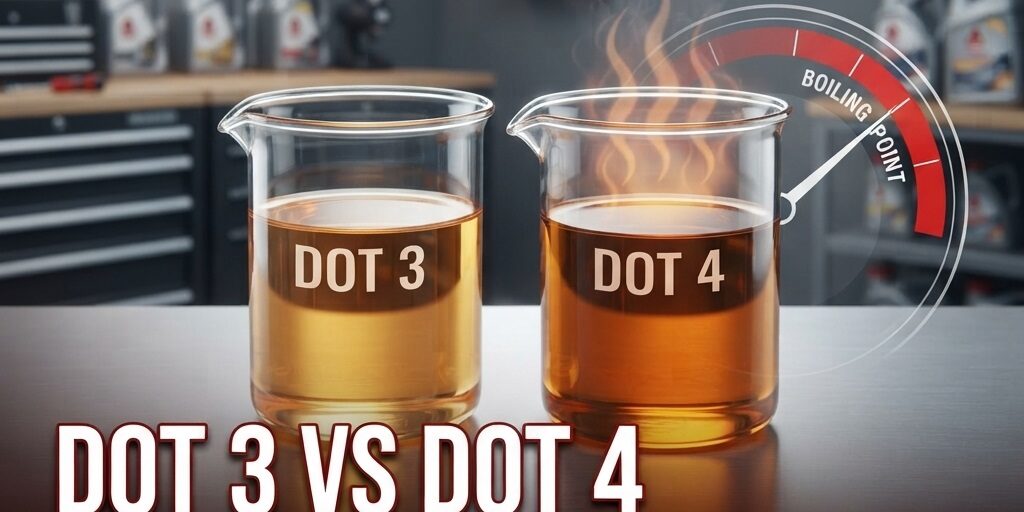
When performing routine maintenance on a vehicle’s hydraulic system, selecting the correct hydraulic fluid is critical for maintaining safe stopping distances. Among the various ratings stamped onto master cylinder reservoir caps, two specifications dominate the automotive market: DOT 3 and DOT 4. While both glycol-ether formulations serve the exact same core purpose of transmitting pedal force to the wheel calipers, their chemical composition, thermal thresholds, and boiling points differ significantly. Understanding the technical contrasts inherent in DOT 3 vs DOT 4 brake fluid helps vehicle owners make informed purchasing decisions that protect their braking systems against vapor lock and thermal fade.
Chemical Composition and Boiling Point Metrics
The fundamental difference between these two hydraulic fluids lies in their chemical additives and thermal resilience. Both types are hygroscopic, meaning they naturally absorb moisture from the atmosphere over time. However, their boiling point standards measured in dry condition (fresh from a sealed bottle) and wet condition (after absorbing approximately three percent water) set them apart.
- DOT 3 Standards: Formulated with a standard glycol-ether base, requiring a minimum dry boiling point of 205 degrees Celsius and a wet boiling point of 140 degrees Celsius.
- DOT 4 Standards: Enhanced with borate ester chemical additives that provide superior thermal stability, raising the minimum dry boiling point to 230 degrees Celsius and the wet boiling point to 155 degrees Celsius.
This higher thermal threshold makes DOT 4 exceptionally resistant to boiling when subjected to the intense frictional heat generated during aggressive driving, heavy towing, or stop-and-go urban commuting. To ensure these technical specifications are properly evaluated and serviced, motorists can review the brake oil shop services guide to guarantee expert handling during fluid replacements.
Application Suitability and Vehicle Requirements
Vehicle manufacturers specify a particular fluid grade based on the weight, braking configuration, and intended operating environment of the car or motorcycle. Installing the wrong specification can lead to compromised hydraulic performance or premature seal degradation.
| Fluid Specification | Minimum Dry Boiling Point | Minimum Wet Boiling Point | Typical Vehicle Application |
| DOT 3 | 205°C (401°F) | 140°C (284°F) | Older hatchbacks, standard sedans, and light commuter motorcycles |
| DOT 4 | 230°C (446°F) | 155°C (311°F) | Modern passenger cars, ABS-equipped vehicles, and performance bikes |
While both fluids share chemical compatibility and can technically be mixed in an emergency without causing immediate seal destruction, doing so dilutes the higher boiling point of the DOT 4 fluid. It is always best practice to maintain the exact grade specified on your vehicle’s reservoir cap. Maintaining consistent maintenance schedules is equally important for overall road safety; vehicle owners can learn more by exploring the regular brake oil checks guide to understand how routine inspections prevent unexpected brake fade.
Moisture Absorption and Maintenance Implications
Because both fluid types are hygroscopic, moisture infiltration remains the primary enemy of hydraulic efficiency. Over eighteen to twenty-four months, microscopic water molecules seep through rubber hoses and reservoir caps, gradually lowering the fluid’s boiling point. When moisture-laden fluid heats up during heavy braking, the trapped water turns to steam, creating compressible vapor pockets that result in a spongy pedal and reduced stopping power. Because DOT 4 fluids generally hold up slightly better against thermal stress, they are preferred for vehicles operating in humid regional climates.
Professional Sourcing and Quality Assurance
Sourcing genuine, factory-sealed fluid is just as vital as choosing the correct DOT rating. The automotive aftermarket contains unverified products that lack proper anti-corrosion additives, leading to rusted internal master cylinder bores and degraded rubber components.
At the Makki Oil Store, we supply certified, high-performance automotive and motorcycle lubricants designed to withstand regional thermal extremes, ensuring your braking system delivers dependable stopping power on every journey.
Frequently Asked Questions
Can I upgrade from DOT 3 to DOT 4 brake fluid in my car?
Yes, you can safely upgrade from DOT 3 to DOT 4 in most standard braking systems because both are glycol-ether based and use compatible rubber seals. The DOT 4 fluid offers a higher boiling point, providing better resistance to heat fade during heavy driving. However, you should always perform a complete system flush rather than simply topping off.
What happens if I mix DOT 3 and DOT 4 brake fluids together?
Mixing DOT 3 and DOT 4 fluids is not mechanically harmful because both share a compatible glycol-ether foundation. However, mixing them will dilute the higher boiling point of the DOT 4 fluid, reducing its overall thermal performance. If your vehicle requires DOT 4, it is always recommended to flush the entire system with the correct grade.
Can I use DOT 4 fluid in a motorcycle that specifies DOT 3?
Yes, using DOT 4 fluid in a motorcycle designed for DOT 3 is completely safe and provides an extra safety margin against boiling during aggressive riding or hot weather. Always check your motorcycle’s reservoir cap to confirm compatibility and avoid using silicone-based DOT 5 unless explicitly designated by the manufacturer.
How often should DOT 4 brake fluid be replaced compared to DOT 3?
Both DOT 3 and DOT 4 brake fluids should ideally be replaced every twenty-four months or approximately every forty thousand kilometers. Because both formulations absorb atmospheric moisture at similar rates, calendar-based replacement is more critical than mileage alone to prevent internal corrosion and vapor lock.
Does DOT 4 cost significantly more than DOT 3?
DOT 4 fluid is generally slightly more expensive than standard DOT 3 due to the advanced borate ester additives required to achieve higher boiling points. However, the price difference is minimal, and the enhanced thermal protection makes the small investment well worth it for modern driving conditions.
Meet the Author
Muhammad Ikram | Founder of Makki Oil Store
With over 25 years of practical industry experience, Muhammad Ikram is one of Lahore’s most experienced voices in automotive lubrication and vehicle care. He founded Makki Oil Store in 1999 with a clear mission: to protect vehicle engines by providing genuine, high-quality lubricants paired with expert maintenance advice.
Over the last two and a half decades, Muhammad has developed a deep, practical knowledge of engine mechanics, fluid chemistry, and local driving demands. Whether dealing with high-mileage daily drivers, modern imported vehicles, or heavy-duty power equipment, his hands-on approach ensures that every customer receives the precise care needed to keep their engine running smoothly for years to come.