One of the most frequent questions car owners ask is exactly how many kilometers they can drive before their next service. While the “5,000 km rule” was once the universal standard, modern advancements in lubricant chemistry and engine design have made this a dynamic decision. As the leading authority at Makki Oil Store, we recognize that for drivers in Lahore, the answer depends heavily on your specific oil type, vehicle age, and the intense environmental stress of the Punjab climate.
The Critical Role of Mileage in Oil Degradation
Engine oil is the lifeblood of your vehicle, providing the essential lubrication required to minimize friction among fast-moving internal parts. However, oil is a consumable product. As you clock up kilometers, the oil undergoes thermal breakdown and accumulates microscopic debris.
Timely oil changes do more than just maintain performance; they are the primary factor in extending your engine’s lifespan. Ignoring these intervals leads to a buildup of abrasive sludge, which can result in “oil starvation” and expensive engine restorations down the road.
Determining Your Ideal Oil Change Interval
To find the perfect balance between engine protection and maintenance costs, you must consider three primary factors:
1. Manufacturer Recommendations
The first place to look is your vehicle’s owner’s manual. Manufacturers provide baseline kilometer intervals carefully crafted to meet the unique tolerances of your specific engine model. However, these are often based on “ideal” driving conditions, which rarely exist on the congested streets of Pakistan.
2. Type of Oil Used
The chemical composition of your lubricant is the biggest variable in mileage.
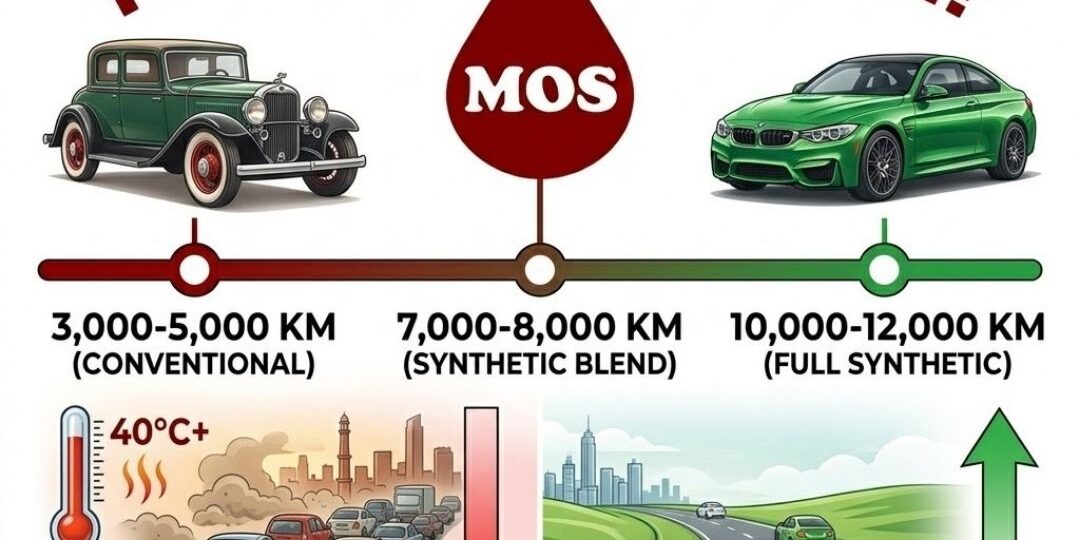
- Conventional Mineral Oil: Typically needs to be changed every 3,000 to 5,000 km in local conditions.
- Synthetic Blend Oil: Offers a middle ground, often lasting between 7,000 and 8,000 km.
- Full Synthetic Oil: Engineered for longevity, these high-tier fluids can often go 10,000 to 12,000 km, provided the oil filter is also of premium quality.
3. Lahore’s Environmental Impact
In Pakistan, where summer temperatures frequently exceed 40°C and dust levels are high, oil degrades much faster than the global average [cite: 2026-03-01]. Frequent stop-and-go traffic in cities like Lahore constitutes “severe driving conditions,” which generally requires you to shorten your change interval by at least 20% to ensure maximum protection. To source the most durable fluids for this climate, visiting the Best Car Engine Oil Shop In Lahore ensures you get products with the thermal stability required for our region.
Signs You Shouldn’t Wait for the Kilometers
Sometimes, your engine will signal for a change long before you hit your mileage target. You should seek an immediate oil change if you notice:
- Dashboard Warnings: The oil pressure light or “check engine” light illuminates.
- Audible Distress: Unusual ticking or metallic knocking sounds coming from the engine bay.
- Dipstick Inspection: The oil appears dark, opaque, or gritty when wiped on a clean cloth.
- Exhaust Smoke: Blue or gray smoke, which often indicates the oil has become too thin to stay out of the combustion chamber.
Best Practices for Peak Performance
To maximize the kilometers between changes, Makki Oil Store recommends a proactive approach. Frequent monitoring of oil levels allows you to identify leaks or consumption issues before they become terminal. Always pair high-quality oil with a premium filter to ensure contaminants are successfully trapped.
While mileage is a great guideline, it isn’t the only factor. If you allow your car to sit for months without driving, the oil can still oxidize and lose its effectiveness. Understanding What Happens To your Car When You Don’t Change your Engine Oil is crucial for every driver to realize that even a low-mileage car needs fresh lubricant to prevent internal rust and sludge buildup.
Frequently Asked Questions (FAQs)
Does the 5,000 km rule still apply to modern cars?
With full synthetic oils, many modern cars can easily exceed 10,000 km. However, in the extreme heat and dust of Lahore, sticking closer to a 7,000–8,000 km interval is a safer bet for long-term reliability.
Can I wait longer if I only drive on the highway?
Yes. Highway driving is “easy” on oil because the engine runs at a steady temperature with plenty of cooling airflow. City driving in Lahore is “harsh” and requires more frequent changes.
Why does dust in the air affect my oil change kilometers?
Microscopic dust particles can bypass the air filter and enter the engine. The oil picks these up to prevent them from scratching the metal, but this “saturates” the oil faster, requiring an earlier change.
Should I change my oil based on months or kilometers?
You should follow whichever comes first. If you haven’t hit your kilometer limit in six months, you should still change the oil, as moisture and acids can build up in the sump over time.
How do I know if my engine is “burning” oil between changes?
Check your dipstick every 1,000 km. If the level is dropping significantly but there are no puddles under the car, your engine is likely consuming the oil internally, which signals a need for a mechanical check.
Is it okay to mix two different brands if they have the same kilometers?
While not ideal, it is safe in an emergency. However, different brands use different additive packages, so a full change at Makki Oil Store with a consistent brand is better for long-term stability.
Does “High Mileage” oil actually last for more kilometers?
“High Mileage” oil is designed for engines with over 100,000 km. It doesn’t necessarily last longer, but it contains seal conditioners that help prevent leaks in older engines.
Why is the oil filter just as important as the kilometers?
If the filter is clogged, it cannot clean the oil. Even if you have fresh oil, a dirty filter will trigger a bypass valve, sending unfiltered, abrasive oil back into your engine parts.
Can the wrong oil weight affect my fuel average over long distances?
Absolutely. Using an oil that is too thick creates “drag” in the engine, which can decrease your fuel efficiency by several percentage points over a few thousand kilometers.
What is the risk of going 2,000 km over my limit?
Going slightly over once might not kill your engine, but repeated neglect causes “sludge” to bake onto the internal surfaces, eventually leading to a complete engine seizure.